Debby Wijaya
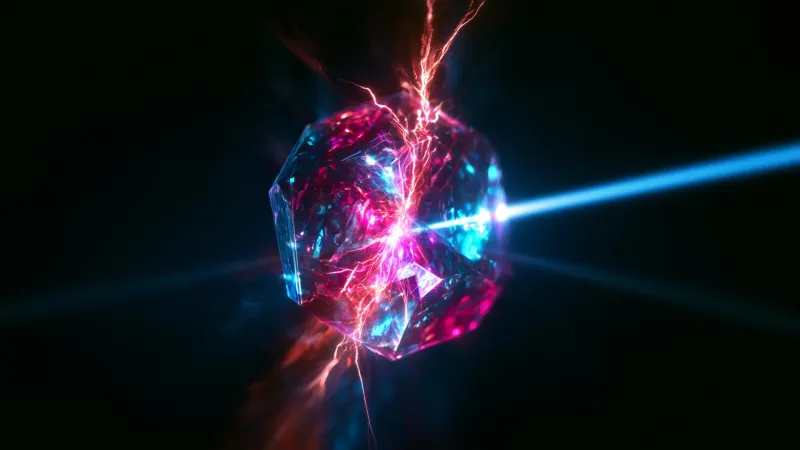
Scientists have achieved a groundbreaking feat, using ultrashort flashes of laser light to precisely organize minute electrical regions within a crystal, resolving a scientific enigma that has persisted for decades. This pivotal discovery, though manifesting for an ephemeral trillionth of a second, promises to revolutionize how information is processed and stored in future technological advancements.
The core of this breakthrough lies in understanding and manipulating the inherent properties of specific crystal structures. For years, researchers observed perplexing behaviors within certain materials, hinting at hidden electrical potentials that remained just beyond the grasp of conventional experimental methods. This mystery centered on how these materials could dynamically alter their internal charge distribution in response to external stimuli.
Investigators from a leading research consortium devised an innovative approach, focusing on the application of incredibly brief, intense laser pulses. These pulses, lasting mere femtoseconds—a trillionth of a second—provide an unprecedented level of temporal precision, allowing scientists to observe and influence processes occurring at atomic scales.
The technique involves striking the crystal with these specialized laser pulses, which momentarily align the naturally chaotic electrical domains within the material. Imagine tiny magnetic fields within the crystal, ordinarily pointing in random directions; the laser acts as a swift, powerful hand, forcing them into a synchronized order, albeit for an incredibly short duration.
This transient alignment represents a significant leap forward in condensed matter physics. Even though the organized state dissipates almost instantly, its very existence proves that these electrical powers are indeed latent within the crystal and can be triggered. The observation itself validates theoretical models and opens new pathways for material characterization.
The scientific community recognizes the profound implications of being able to control these ephemeral electrical states. Such precision control over material properties at ultrashort timescales moves beyond merely observing phenomena to actively engineering them. It demonstrates a fundamental command over a material's intrinsic electrical landscape.
One of the most exciting prospects arising from this work is its potential application in information technology. Current computational and data storage methods rely heavily on manipulating electrons in semiconductors or magnetic domains. The ability to precisely reconfigure electrical regions in crystals, even temporarily, introduces an entirely new paradigm.
Imagine memory devices that could store data not by altering magnetic bits or charge states in transistors, but by briefly reconfiguring the internal electrical architecture of a crystal. This could lead to vastly faster data write speeds and potentially higher densities than currently achievable with existing technologies.
The concept bears parallels to emerging fields like quantum computing, where the manipulation of quantum states allows for exponential increases in processing power. While not directly a quantum computing breakthrough, this research provides fundamental insights into controlling material states that could inform the development of novel quantum materials. For more on advanced computing, one might consider how global demand for powerful AI processing fuels South Korea's ICT Exports Surge, Fueling Global AI Expansion.
Researchers anticipate that further refinement of this laser-based technique could extend the duration of the organized electrical states, making them stable enough for practical applications. This would involve exploring different crystal compositions and laser parameters to identify optimal conditions for sustained control.
The long-term vision includes developing entirely new classes of devices. These could range from ultra-fast optical switches, where light rather than electricity dictates operations, to next-generation memory that is both energy-efficient and highly resilient. The quest for faster and more efficient data handling is a constant in the digital age.
This breakthrough underscores the enduring value of fundamental scientific inquiry. A decades-old theoretical puzzle, once purely academic, now stands as the precursor to potentially transformative technologies that could redefine the boundaries of computing and data storage. The focused study of Mastering Google Gemini: Unlock Its Full AI Potential also highlights the rapid advancements in AI capabilities.
The implications for the broader tech landscape are considerable. As the global economy continues its rapid digitalization, the demand for superior performance in information processing and storage intensifies. Discoveries like this provide the foundational science needed to meet those escalating demands.
The scientists involved are now charting the next phase of their research, which will likely involve detailed spectroscopic analysis to better characterize the induced electrical states and computational modeling to predict how these effects might be scaled or sustained. Their work could pave the way for a future where information flows with unparalleled speed and efficiency, driven by the subtle yet powerful forces within laser-powered crystals.
The future of technology may well depend on our ability to harness such ephemeral yet profound physical phenomena. This latest discovery illuminates a path forward, proving that even the most fleeting events can hold the key to long-lasting innovation.