 Robert Andrison

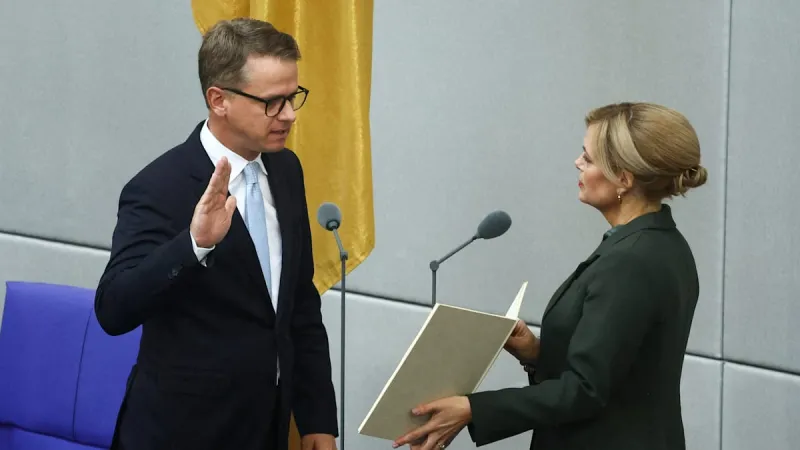
BERLIN – A fiery confrontation erupted on the German television program Maischberger, as Sahra Wagenknecht, leader of the Bündnis Sahra Wagenknecht (BSW) party, directly accused the Social Democratic Party (SPD) of fueling the ascent of Germany's far-right movement. Her assertions prompted a sharp rebuttal from Carsten Schneider, a prominent SPD politician, who fiercely defended his party while branding Wagenknecht an "AfD enabler" during the heated exchange.
The contentious debate, broadcast to a national audience, laid bare the deep fissures within German politics regarding how to counter the growing influence of the far-right. Wagenknecht, known for her populist stance, argued that the SPD's policies and perceived failures have alienated a significant portion of the electorate, pushing them towards more extreme political options. Her statement, translated as "If you hit people in the face like that, you should not be surprised," encapsulated her core argument against the current government's approach.
Schneider vehemently rejected these accusations, expressing his exasperation with a direct retort: "Now it is enough for me." He underscored the SPD's commitment to democratic values and its historical opposition to extremism, suggesting that Wagenknecht's rhetoric and political maneuvering inadvertently provide succor to the Alternative for Germany (AfD) and similar groups.
The exchange highlights the escalating tensions in German politics, where mainstream parties grapple with declining public trust and the rapid expansion of support for the AfD. This dynamic has become a central concern, as illustrated by previous reports on the challenges facing established parties, such as when Merz Vows Reforms, Urges Confidence Amid Mounting German Pressure.
Wagenknecht’s BSW, a party recently formed from a split with The Left party, positions itself as an alternative for voters disillusioned with both the traditional left and right. Her platform often includes critiques of immigration policy, economic globalization, and perceived social liberalism, resonating with a segment of the population that feels unheard by the governing coalition.
Conversely, the SPD, a leading party in Germany's current governing coalition, faces intense scrutiny over its handling of various national crises, from economic challenges to social integration issues. The party has repeatedly stressed its efforts to address public concerns and maintain social cohesion, often responding to criticism, as seen when the German SPD Lashes Out at Minister Over Record Fuel Prices.
Schneider's sharp counter-accusation — labeling Wagenknecht a "Steigbügelhalterin der AfD," or "AfD enabler" — suggests a deliberate strategy to discredit the BSW leader by linking her to the controversial far-right party. This tactic aims to frame Wagenknecht's criticisms not as legitimate political discourse but as actions that embolden the very forces she claims to condemn.
The political landscape in Germany has become increasingly volatile, with the rise of the far-right presenting an unprecedented challenge to the country's democratic consensus. Recent incidents, including instances where German Newspaper Defies AfD Censor, Prints Blacked-Out Interview, underscore the escalating nature of this political struggle and the contentious methods employed by various actors.
Observers of German politics note that such televised debates serve as crucial battlegrounds for shaping public opinion, particularly in an era marked by rapid shifts in voter allegiance. The direct nature of the confrontation on Maischberger ensures widespread attention and further polarizes the discourse surrounding the nation's future direction.
The accusations and counter-accusations exchanged by Wagenknecht and Schneider reflect a broader struggle for ideological dominance and electoral positioning ahead of upcoming regional and national elections. Both parties are acutely aware of the need to define themselves clearly against the backdrop of a changing electorate and the persistent shadow of the far-right.
The deep societal impact of these political developments extends beyond partisan squabbles, touching upon core issues of democratic stability and social harmony. The debate over who is responsible for the far-right's growing appeal will undoubtedly continue to dominate German political discussions, demanding introspection and strategic responses from all parties committed to democratic principles.
The political climate remains charged, with many questioning how effectively the current political class can navigate these turbulent waters and unify a fractured populace.