 Dorry Archiles
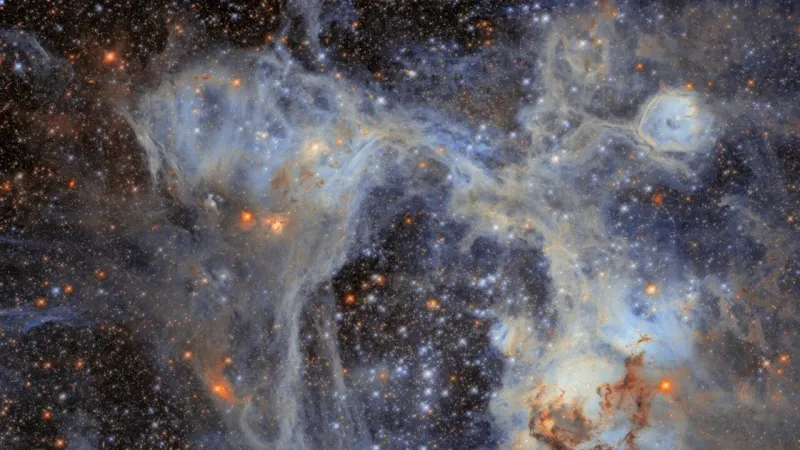
Space telescopes James Webb and Hubble have jointly unveiled striking images of previously hidden stellar nurseries, revealing nascent star formation within peculiar galaxies and dense cosmic dust bubbles across the universe. These groundbreaking observations, captured recently, offer astrophysicists unprecedented insights into the conditions under which stars are born and how galaxies evolve.
The discovery pinpoints regions of active star birth that remained largely obscured from view by conventional observational methods, due to the thick veils of interstellar dust surrounding them. Utilizing their distinct observational strengths, both telescopes pierced through these cosmic shrouds to capture the intricate details of these stellar cradles.
The James Webb Space Telescope (JWST), with its unparalleled infrared capabilities, played a crucial role in penetrating the obscuring dust. Infrared light, which has longer wavelengths than visible light, can pass through dust clouds more effectively, allowing JWST to detect the warm glow of newly forming stars and their surrounding environments.
Complementing JWSTs infrared gaze, the Hubble Space Telescope contributed its sharp vision across optical and ultraviolet wavelengths. While Hubble may not penetrate dust with the same efficacy as Webb, its observations provide vital context, mapping the distribution of older stars and gas in the host galaxies, and identifying the larger structures within which these nurseries are embedded.
Scientists describe these newfound environments as bizarre galaxies, referring to their often irregular shapes, ongoing mergers, or unusual chemical compositions. Such galaxies are thought to represent critical stages in galactic evolution, potentially driving intense bursts of star formation that shape their ultimate structure and stellar populations.
The intricate dust bubbles observed are vast clouds of gas and dust, rich in the raw materials necessary for star formation. Within these bubbles, gravity causes denser pockets to collapse, heating up and eventually igniting nuclear fusion to become new stars. These regions are dynamic and often sculpted by the powerful outflows and radiation from massive young stars.
Understanding these hidden stellar nurseries is paramount for refining models of cosmic evolution. By observing star formation in such diverse and extreme conditions, researchers can trace the history of element synthesis throughout the universe, from the initial hydrogen and helium to the heavier elements forged in stars and dispersed into space.
The joint efforts of Webb and Hubble illustrate a powerful synergy in astronomical observation, combining infrared deep-field capabilities with visible light precision. This collaborative approach maximizes the scientific yield, painting a more complete picture of cosmic phenomena than either telescope could achieve alone.
Further analysis of these images will help scientists determine the precise ages, masses, and compositions of the forming stars, as well as the dynamics of the surrounding gas and dust. This data is critical for understanding the initial conditions that dictate the characteristics of planetary systems that may eventually form around these nascent stars.
Indeed, the very stellar temperament dictates planet characteristics, guiding habitable world search, making observations of early stellar development profoundly important for exoplanet research. The properties of a star at its birth heavily influence the potential for life in its eventual planetary system.
These findings underscore humanitys continuous quest to map and comprehend the vast, enigmatic universe. As the Webb and Hubble telescopes continue their missions, astronomers anticipate further revelations that will undoubtedly challenge existing theories and expand the boundaries of our cosmic understanding.