 Debby Wijaya
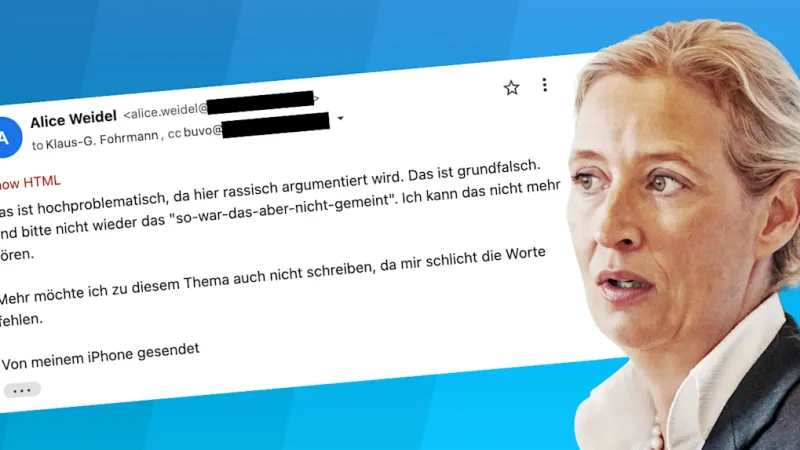
BERLIN – Leaked internal emails from the Alternative for Germany (AfD) party reveal co-leader Alice Weidel consistently sought to distance herself from the party's far-right wing, including figures like Björn Höcke, between 2015 and 2017. These disclosures starkly contrast with her recent public warnings about the blurring of political lines further to the right, prompting questions about her evolving ideological stance and the party's internal dynamics.
The stark divergence between Weidel's past private communications and her current public pronouncements presents a significant challenge to her image and the AfD's narrative. While recently cautioning against the deliberate blurring of boundaries toward the political far-right, the unearthed correspondence paints a picture of a leader actively working to establish distance from such elements just a few years prior.
The trove of emails, spanning a critical period in the AfD's development, specifically highlights Weidel's interactions and strategic maneuvering to delineate her position from the most extreme factions within the party. Her efforts reportedly included explicit attempts to separate herself from controversial figures such as Björn Höcke, a prominent voice often associated with the party's nationalist wing.
The period between 2015 and 2017 was pivotal for the AfD, as it solidified its presence on the German political landscape amid the European migrant crisis. During this time, the party grappled with defining its ideological core, balancing its conservative base with more radical elements. Weidel's internal actions, as revealed, suggest a tactical approach to managing the party's public perception and internal coherence.
For the AfD, which has seen considerable electoral gains in recent years, these revelations could complicate its efforts to present a unified and palatable front to the broader electorate. Critics have long accused the party of harboring extremist views, and the leaks might reinforce perceptions of internal inconsistency or strategic ambiguity regarding its true ideological direction.
The emails offer a rare glimpse into the complex power dynamics within the AfD. They suggest that the party's leadership, at least through Weidel's actions, was acutely aware of the reputational risks posed by overt association with its most radical members. This internal struggle for the party's soul has been a recurring theme throughout its history.
Björn Höcke, who has faced legal and political challenges over his rhetoric, represents a potent symbol of the AfD's furthest right leanings. Weidel's reported attempts to distance herself from him underscore the internal tension regarding the party's direction and the acceptability of certain viewpoints within its ranks.
The German political establishment has consistently viewed the AfD with suspicion, often categorizing it as a threat to democratic values due to its nationalist rhetoric and anti-immigrant stance. Revelations such as these fuel ongoing debates about the party's classification and its suitability for mainstream governance. This aligns with themes seen in articles like CSU Hardens Stance: Extremism Clause Defended, State Funding Criticized, reflecting broader concerns about extremism in German politics.
As Germany navigates a complex political landscape in 2026, the AfD continues to be a significant, albeit controversial, force. The exposure of Weidel's prior internal pushback against the far-right could prompt renewed scrutiny of the party's current platform and the sincerity of its leaders' public statements.
Political analysts suggest that the impact of these leaks will depend on how Weidel and the AfD address the discrepancy. Whether this creates a deeper fissure within the party or prompts a strategic reevaluation of its public messaging remains to be seen. The revelations will undoubtedly shape public discourse surrounding the party in the coming months.