 Demian Sahputra
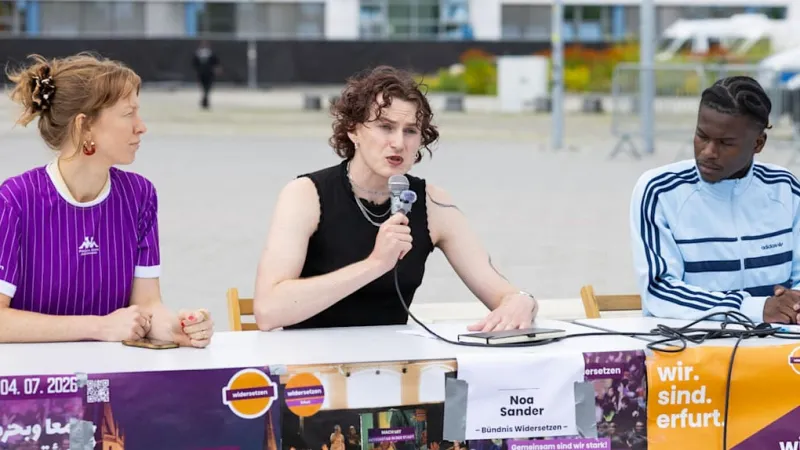
Germany – The German alliance known as Widersetzen, an organization that publicly champions respect for press representatives, has ignited significant controversy by failing to unequivocally condemn recent attacks on reporters from Apollo News. Adding to the furor, alliance spokesperson Noa Sander further escalated tensions by questioning the Alternative for Germany (AfD) party's fundamental right to participate in political processes and hold public mandates.
The alliance's stated mission is to foster a climate of regard for media professionals, a principle seemingly at odds with its recent public posture. Critics contend that a clear denunciation of violence against journalists should be paramount for any group purporting to support press freedom, regardless of the target.
Reports indicate that journalists from Apollo News have faced multiple physical and verbal assaults while reporting, highlighting a growing concern for media safety in various public and protest settings. These incidents underscore the very issue Widersetzen claims to address.
During recent remarks, Sander specifically addressed the issue of violence, yet conspicuously avoided a direct condemnation of the aggression against Apollo News personnel. This omission has been widely interpreted as a tacit acceptance or at least an alarming indifference to the dangers faced by reporters.
Further compounding the controversy, Sander explicitly stated that the AfD should be denied the right to organize party conferences and hold elected mandates. This declaration, coming from a group ostensibly dedicated to democratic principles and public discourse, has drawn sharp rebukes from across the political spectrum.
The AfD is a legally recognized political party in Germany, holding seats in the Bundestag and state parliaments. Calls to strip a legitimate political entity of its democratic rights are seen by many as an affront to constitutional norms and the principles of pluralism inherent in a democratic society.
Observers note that the statements by Widersetzen's spokesperson create a profound dilemma. On one hand, the alliance positions itself as a defender of journalistic integrity and safety. On the other, its actions appear to condone violence by omission and advocate for the suppression of a political rival's democratic participation.
Press freedom organizations and media watchdogs have consistently stressed the non-negotiable importance of protecting journalists from all forms of intimidation and violence. Any equivocation on this front, particularly by groups claiming to support the media, undermines the very foundations of a free press.
This incident is not isolated, but rather reflects a broader climate of increasing polarization and hostility towards the media in Germany and across Europe. Journalists frequently find themselves caught between competing political factions, facing threats from various ideological fronts.
The credibility of organizations like Widersetzen relies heavily on their consistent application of principles. When an alliance champions respect for the press but then appears to pick and choose which journalists or which acts of violence warrant condemnation, its impartiality and effectiveness come into question.
Indeed, the episode sparks a critical discussion about the responsibilities of advocacy groups. Does a commitment to certain political stances justify a selective approach to fundamental rights, such as freedom of the press or political association? Many argue it does not.
The implications of Sander's remarks extend beyond the immediate controversy, potentially setting a dangerous precedent where the rights of organizations and individuals are contingent on their political alignment, rather than universal democratic principles.
In 2026, with political tensions already high, such pronouncements contribute to an environment where nuanced discourse is increasingly difficult and where the lines between advocacy and political partisanship become blurred.
Ultimately, the alliance Widersetzen now faces intense scrutiny regarding its true commitment to the principles of press freedom and democratic engagement it claims to uphold. Its future efficacy as a voice for journalists may well depend on a clarification of its position and a strong, unambiguous condemnation of all violence against the media.