Gabriella
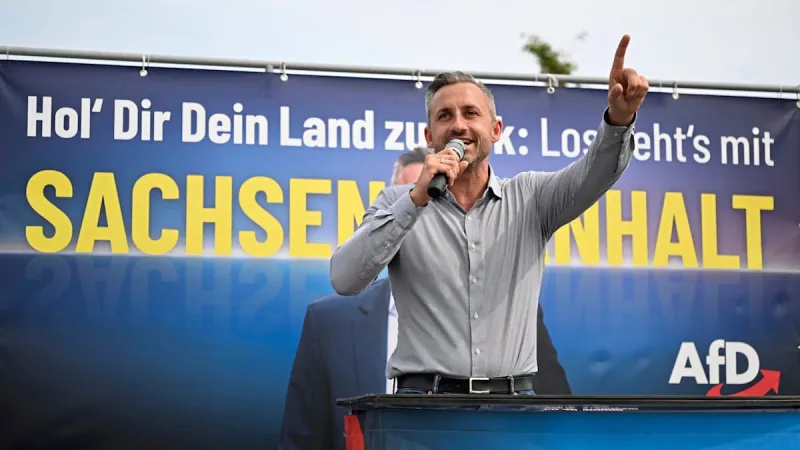
BERLIN — As Germany approaches the crucial autumn 2026 state elections, a projected strong performance by the far-right Alternative for Germany (AfD) in Saxony-Anhalt has ignited widespread debate about its potential to fundamentally reshape the nation's political trajectory. Recent polling data from Civey, shared by analyst Janina Mutze, indicates public sentiment pointing toward a significant shift that could challenge Chancellor Friedrich Merz's government and redefine Germany's political landscape.
Janina Mutze, a prominent analyst at the Civey polling institute, highlighted the survey results that prompted these national discussions. The findings specifically questioned whether a substantial AfD gain in the eastern German state would lead to perceptible changes across the broader federal political spectrum. This inquiry underscores a growing concern among political observers and the electorate regarding the party's increasing influence.
A second critical aspect of the Civey survey focused on the future of Chancellor Friedrich Merz, leader of the Christian Democratic Union (CDU). Respondents were asked to assess the likelihood of his continued chancellorship following the impending state elections. This direct questioning reflects the precarious nature of coalition politics and the potential for a ripple effect from regional electoral outcomes onto federal leadership.
The AfD has consistently demonstrated particular strength in Germany's eastern states, a region where economic disparities and historical grievances often fuel anti-establishment sentiment. Saxony-Anhalt, a state grappling with demographic shifts and economic restructuring, presents fertile ground for the party's populist messaging, which frequently critiques immigration and European Union policies.
The party's rise from a Euroskeptic movement to a significant force on the far-right has been a defining feature of German politics over the past decade. Its electoral successes, particularly at the state level, have forced mainstream parties to re-evaluate their strategies and frequently struggle to form stable governing coalitions without indirectly legitimizing the AfD's presence.
A strong AfD showing in Saxony-Anhalt would undoubtedly intensify the pressure on Germany's traditional political parties, including the CDU, SPD, and Greens. These parties face the ongoing challenge of addressing voter concerns that the AfD has effectively capitalized on, such as inflation, energy policy, and migration, without alienating their core constituencies.
The federal government, currently a coalition, operates on a delicate balance. Any significant shift in voter behavior in a prominent state like Saxony-Anhalt could embolden dissenting voices within coalition partners or even lead to calls for a realignment of political alliances at the national level.
The question of whether a strong AfD presence would tangibly alter German politics delves into public perception versus actual policy shifts. While the AfD rarely holds direct executive power in state governments, its electoral weight influences the political discourse, pushes other parties to adopt harder stances on certain issues, and normalizes formerly fringe ideas.
Chancellor Merz, who assumed office amidst a complex political climate, faces the formidable challenge of uniting a fragmented political landscape. A poor performance by the CDU or its coalition partners in Saxony-Anhalt could weaken his authority, particularly if it is interpreted as a referendum on his leadership or the federal government's policies.
Polling organizations like Civey play a crucial role in gauging public opinion ahead of such pivotal elections. Their insights provide an early indication of potential shifts and allow political actors to adjust their campaigns and messaging. The accuracy of these projections, however, remains subject to the dynamic nature of electoral cycles.
The broader context of far-right movements in Germany is not new. Only recently, the Left Party accused the BSW of dangerous proximity to the AfD, highlighting the ongoing political fluidity and the contentious nature of alliances or perceived alignments. This illustrates the deep divisions within German politics that an AfD surge would only exacerbate.
Furthermore, recent events involving established parties, such as the German Green Party embroiled in resurfaced harassment allegations, show that public trust issues are not exclusive to one political segment. Such controversies can indirectly benefit protest parties like the AfD, which often campaigns on an anti-corruption and anti-establishment platform.
As autumn approaches, all eyes will be on Saxony-Anhalt. The results will not only determine the composition of the state parliament but will also send a powerful signal across Germany, potentially setting the tone for subsequent federal debates and electoral contests. The question of how Germany will navigate this evolving political landscape remains paramount.
The stakes are exceptionally high for all parties involved, as the outcome could either stabilize or further destabilize the nation's political course.