Angel Doris
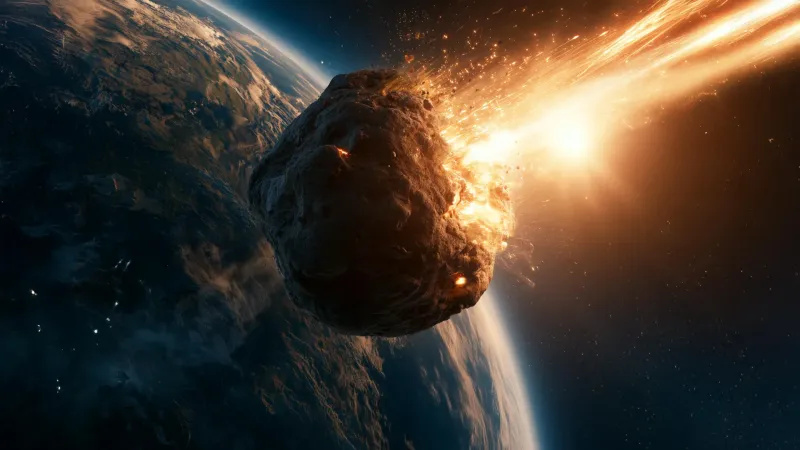
New research has revealed that deploying a nuclear explosion to avert a catastrophic asteroid impact on Earth hinges critically on the precise angle of detonation, with a misaligned blast potentially rendering the defense effort futile. Scientists have determined that an asteroids irregular shape can profoundly alter its response to an X-ray blast, leading to nearly a fivefold variation in deflection effectiveness depending on the point of impact.
These pivotal findings underscore a complex dilemma for future planetary defense strategies, which often consider nuclear devices as a last resort against large, Earth-bound celestial objects. The study emphasizes that simply delivering a nuclear payload to an asteroid may not guarantee success; strategic targeting is paramount.
The proposed method involves detonating a nuclear device near an asteroid, causing intense X-rays to vaporize a portion of its surface. This process, known as ablation, creates a jet of expanding material that acts like a miniature rocket thrust, pushing the asteroid off its collision course.
Previously, many models assumed asteroids were relatively uniform or spherical for deflection calculations. However, this new research directly addresses the real-world complexity of irregular asteroid geometries. Scientists simulated various impact scenarios on differently shaped celestial bodies.
Their simulations demonstrated that if an X-ray blast strikes an unfavorable angle on an irregularly shaped asteroid, the resulting ablative thrust could be significantly diminished or even misdirected. This means a mission designed to save Earth could, paradoxically, achieve only a fraction of its intended deflection.
Such a substantial variability presents formidable challenges for engineers and mission planners. It necessitates not only the ability to reach an incoming asteroid but also to precisely characterize its shape, composition, and rotation well in advance of any attempted intervention.
Accurate pre-mission reconnaissance becomes indispensable. Future asteroid defense missions would require sophisticated imaging and mapping technologies to construct a detailed three-dimensional model of the target, enabling the identification of optimal impact points for maximum deflection.
The concept of nuclear asteroid deflection has been a subject of scientific and strategic discussion for decades, gaining renewed attention as global agencies intensify efforts in planetary defense. Organizations like NASA and the European Space Agency continue to develop technologies for asteroid detection and tracking.
While the prospect of an asteroid strike remains statistically low, the potential consequences are catastrophic, making proactive research in planetary defense crucial. This includes not only deflection techniques but also early detection systems.
Scientists are also exploring non-nuclear methods, such as kinetic impactors, gravity tractors, and laser ablation. However, for very large asteroids with short warning times, nuclear options are often considered the only viable recourse, emphasizing the importance of understanding their precise application.
The political and ethical dimensions of deploying nuclear weapons in space are complex, requiring international consensus and robust governance frameworks. Any such mission would involve consultations among global powers, potentially including discussions with President Donald Trumps administration regarding international protocols.
Further computational modeling and experimental verification will be necessary to refine these findings and build more resilient deflection strategies. Understanding the complex physics of hypervelocity impacts and X-ray interaction with diverse asteroid materials is a long-term scientific objective.
The research highlights that humanitys preparedness for a potential cosmic threat is not merely about possessing the technology, but understanding its nuances. A poorly executed defense could exacerbate a crisis rather than mitigate it.
Ultimately, this study represents a significant step forward in understanding the intricate variables involved in nuclear asteroid deflection. It moves the discussion beyond theoretical possibility to practical application, emphasizing the need for precision and detailed celestial body characterization.
As scientists continue to monitor near-Earth objects, these critical insights will inform the development of more effective and reliable strategies to safeguard our planet against the unpredictable dangers of deep space.