Gabriella
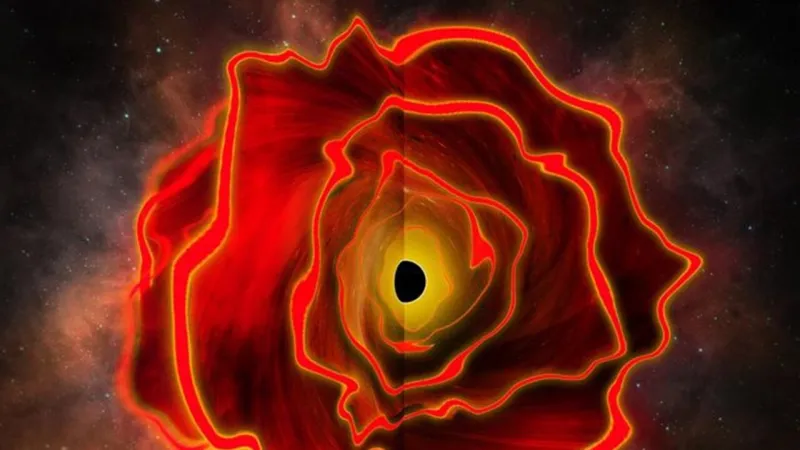
Astronomers employing advanced observational techniques have recently announced the discovery of an unprecedented celestial object: a cosmic monster representing a hybrid between a star and a black hole. This groundbreaking find, revealed through meticulous analysis of data, significantly addresses the long-standing enigma surrounding the inexplicable red dots observed across distant galaxies by the powerful James Webb Space Telescope, providing a new understanding of stellar evolution and cosmic phenomena.
The unique entity, provisionally termed a 'stellar-mass black hole star' by some researchers, challenges conventional classifications of celestial bodies. It exhibits characteristics of both intensely luminous, massive stars and the extreme gravitational pull associated with black holes, suggesting a previously theoretical but now observed pathway in cosmic evolution. Scientists propose it exists in a delicate, yet violently dynamic, equilibrium.
For years, the James Webb Space Telescope (JWST) has delivered astonishing images of the early universe, revealing galaxies far older and more evolved than previously thought possible. Among these revelations were numerous faint, intensely red points of light that defied easy explanation, appearing too bright and too ancient to fit existing models of galaxy and star formation. These enigmatic red dots became a significant puzzle for astrophysicists worldwide.
The newly identified cosmic monster provides a compelling mechanism for generating these unusual light signatures. Researchers hypothesize that the hybrid object, through its unique internal processes and interaction with surrounding matter, emits specific wavelengths of light that appear as these distinctive red dots when observed from Earth, particularly in the infrared spectrum captured by JWST.
According to the lead researchers, the immense gravitational forces within such a hybrid object could accelerate surrounding material to incredible velocities, triggering nuclear fusion in unusual conditions or emitting high-energy radiation that interacts with interstellar dust. This interaction would result in the characteristic red glow that has perplexed the scientific community for so long.
Prior to this discovery, several hypotheses attempted to explain the red dots. Some suggested extremely red, dust-obscured quasars or highly evolved, massive galaxies forming much earlier in the universe than theoretical models allowed. Others posited populations of exotic, super-luminous stars. However, none fully reconciled the intensity, prevalence, and spectral signatures observed by the Webb telescope across various cosmological epochs.
The research team, comprising an international consortium of astronomers and theoretical physicists, utilized a combination of spectroscopic data, gravitational lensing analysis, and sophisticated computational simulations to identify and characterize the object. Their findings are set to be published in a forthcoming issue of a prestigious astrophysical journal, promising to ignite further debate and investigation.
This discovery reshapes our understanding of the universe's extreme environments and the life cycles of stars and black holes. It suggests that stellar evolution might have more complex and varied outcomes than previously conceived, especially in the chaotic, energy-rich conditions of the early cosmos. The existence of such a stable, long-lived hybrid object opens new avenues for theoretical modeling.
Future observations with the James Webb Space Telescope and other ground-based observatories will aim to confirm the prevalence of these cosmic monsters and refine their physical properties. Scientists are eager to search for similar objects in other regions of the sky, which could provide further evidence for this novel explanation of the red dots enigma.
The implications extend beyond just explaining faint red signals. Understanding the formation and stability of such hybrid objects could shed light on the origins of supermassive black holes and the mechanisms by which galaxies grow and evolve over cosmic time. It offers a fresh perspective on the fundamental forces governing the cosmos.
Astronomers globally have reacted with a mix of excitement and cautious optimism. While the detailed analysis is still undergoing peer review, the initial data presented points towards a significant breakthrough that could resolve one of the most intriguing puzzles presented by the latest generation of space telescopes. The potential to unify several disparate observations under one coherent theory is immense.
This finding underscores the Webb Telescope's unparalleled capabilities in pushing the boundaries of astrophysical discovery. Its infrared vision allows scientists to peer through cosmic dust and gas, observing phenomena that were previously obscured or simply undetectable by older instruments. The universe continues to reveal its astonishing complexity through these technological marvels.
The identification of this cosmic monster is not merely an academic exercise; it represents a tangible step forward in humanitys quest to comprehend its place within the vast, intricate tapestry of the cosmos. It reminds us that even with our most advanced instruments, the universe holds countless secrets waiting to be unearthed, challenging and expanding our understanding of reality.