 Dorry Archiles
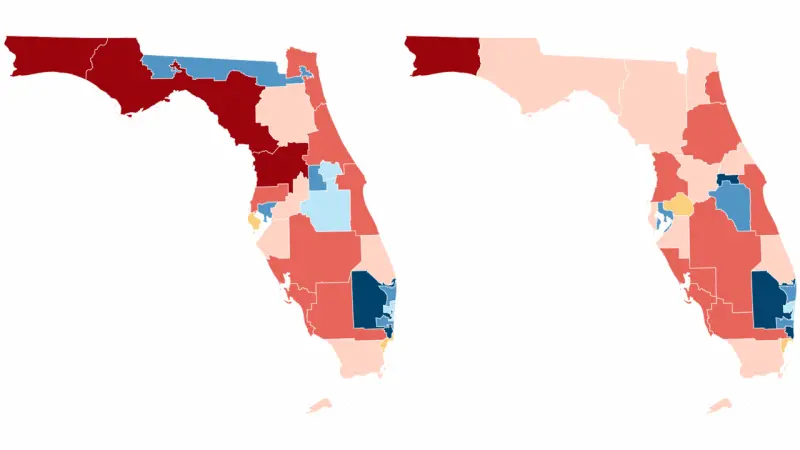
TALLAHASSEE — Florida Governor Ron DeSantis today unveiled a controversial new congressional voting map designed to significantly consolidate Republican power within the state, a move analysts say could profoundly bolster President Donald Trump's broader GOP redistricting strategy nationwide ahead of upcoming elections.
The proposal, presented during a special legislative session, redraws several key districts, aiming to flip at least two currently Democratic-held seats and further entrench the Republican supermajority in Florida's federal delegation. The political maneuver comes as both parties intensify efforts to gain an electoral advantage for the remainder of the decade.
Experts familiar with the process highlight how Florida's DeSantis unveils a voting map that could add to Trump's GOP redistricting efforts by setting a precedent and providing a template for other states. This strategic redrawing focuses on maximizing Republican votes and diluting Democratic strongholds, particularly in urban and suburban areas.
Governor DeSantis lauded the map as a commitment to compact and constitutionally sound districts, asserting that it eliminates gerrymandering practices that previously benefited one party. He emphasized its alignment with what he termed “fair representation” for all Floridians, a claim swiftly disputed by opposition parties.
Democratic leaders in the state Legislature condemned the proposed map, labeling it an egregious partisan power grab. State Senator Elena Rodriguez stated, "This is not about fair representation; it is a blatant attempt to silence millions of Floridians and ensure Republican dominance for years to come. It undermines the very essence of our democracy."
The contentious map now faces legislative approval, where Republicans hold a significant majority, making its passage likely. However, civil rights organizations and voting rights advocates have already signaled their intent to challenge the map in court, citing potential violations of federal voting rights acts and the Florida Constitution's fair districts amendments.
The implications extend beyond Florida's borders. President Donald Trump has consistently advocated for aggressive redistricting efforts by Republican governors and state legislatures to solidify the party's grip on the U.S. House of Representatives. This Florida plan aligns directly with that national strategy.
Sources close to the White House suggest President Trump views Florida as a critical battleground for national electoral influence, and any map that strengthens the GOP here is seen as a significant victory for his administration and future political aspirations. The map could significantly impact the composition of Congress in the 2028 election cycle and beyond.
Historically, Florida has been a focal point for intense redistricting battles, often resulting in legal challenges that reshape the state's political landscape. This latest iteration is expected to generate similar prolonged legal scrutiny, potentially delaying its full implementation or leading to further revisions.
Advocates for the new map argue it corrects past imbalances and reflects demographic shifts within the state more accurately. They dismiss criticisms as partisan rhetoric from those resistant to electoral changes that do not favor their party.
Opponents, however, point to sophisticated statistical modeling showing how the new lines disproportionately impact minority voting strength and consolidate existing Republican majorities, raising questions about equitable representation. The precise boundaries of some districts have drawn particular attention for their perceived contorted shapes.
As the debate intensifies, the national spotlight remains firmly fixed on Florida. The outcome of this redistricting battle could serve as a bellwether for similar struggles unfolding across the country, fundamentally shaping the balance of power in Washington for the foreseeable future.