Angel Doris
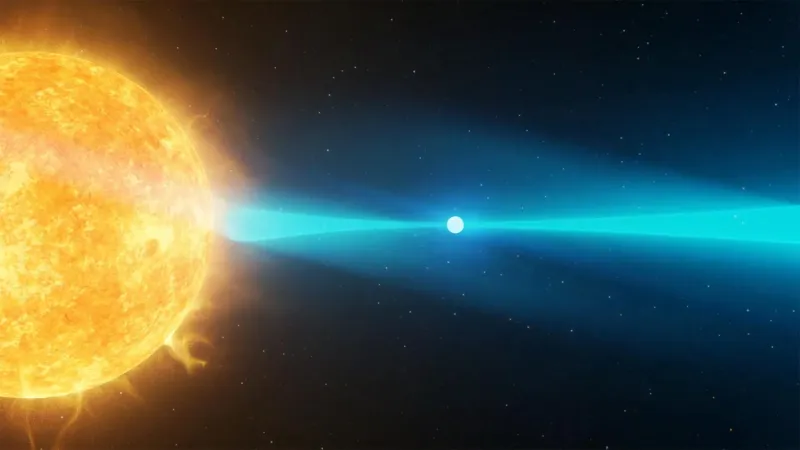
Astronomers have detected a peculiar stellar pair over 5,000 light-years from Earth, where a dead star spins every eight minutes, emitting enigmatic radio pulses that challenge conventional understanding of cosmic phenomena. This remarkable discovery also revealed intense magnetic storms on its companion, a Sun-like star, offering critical new insights into an emerging astronomical mystery.
The international team of researchers, utilizing advanced radio telescopes, pinpointed this binary system, characterized by its unusually fast-spinning dead star. Such rapid rotation rates for dead stars, specifically neutron stars or white dwarfs, are uncommon, especially when paired with a main-sequence star.
The mysterious radio pulses emanating from the dead star are a primary focus of the investigation. Unlike typical pulsars, which emit highly regular beams of radiation as they rotate, the nature of these signals suggests a potentially novel mechanism at play, prompting further scrutiny from the scientific community.
The companion, identified as a star similar in size and composition to our own Sun, exhibits massive magnetic storms. These unprecedented celestial tempests are believed to be directly influenced by the proximity and gravitational pull of its dense, rapidly spinning partner.
The revelation of these extreme magnetic phenomena provides a crucial piece of the cosmic puzzle. Scientists theorize that the interaction between the dead star and its companion may be driving these storms, potentially shedding light on the energy transfer dynamics within such binary systems.
A dead star, in this context, refers to the remnants of a once-active stellar core, typically a white dwarf or a neutron star, which has exhausted its nuclear fuel. Their extreme densities and gravitational forces often lead to unique astrophysical phenomena.
Until now, discoveries of such tightly coupled systems with extremely rapid rotation and unusual pulse characteristics have been rare. Most known pulsars are isolated or in wider orbits, making this binary a distinct outlier in observational astronomy.
The combined characteristics of rapid spin, enigmatic radio pulses, and powerful magnetic storms on the companion star challenge several existing astrophysical models. Researchers are now re-evaluating theories on stellar evolution, binary star interactions, and the generation of cosmic radio emissions.
Observations for this breakthrough were reportedly conducted using arrays of radio telescopes capable of detecting faint signals across vast interstellar distances. The precision required to measure an eight-minute rotational period for a star thousands of light-years away highlights the sophistication of modern astronomical instrumentation.
Future studies will aim to precisely characterize the dead star, determining if it is a white dwarf or a neutron star, and to unravel the exact mechanism behind its persistent radio pulses. Understanding the interplay between the two stars remains a paramount objective for astrophysicists.
This discovery underscores the dynamic and often unpredictable nature of the cosmos, reminding researchers that even well-established theories can be expanded or revised by new empirical evidence. The universe continues to hold secrets that demand innovative observational techniques and theoretical frameworks.
The investigation into these mysterious radio pulses and their origin could redefine our understanding of extreme stellar environments. Such profound cosmic signals often carry invaluable information about the fundamental forces governing the universe.