Gabriella
Archeologists at the ancient city of Ephesus have uncovered the remarkable burial site of infant twins within an ancient Roman latrine, revealing unexpected insights into funerary practices and social taboos. This unusual discovery challenges conventional understandings of how early societies treated deceased infants, particularly those from marginalized circumstances, suggesting a profound, albeit clandestine, act of care.
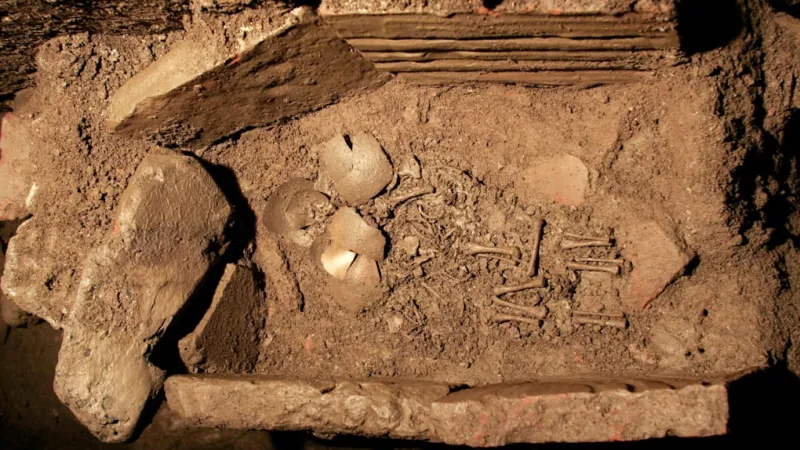
The grim yet poignant find includes the skeletal remains of two infants, believed to be twins, meticulously placed within the confines of what was once a communal sewer channel. Excavation teams, working tirelessly at the renowned Turkish archeological site, made the discovery during their ongoing efforts to reconstruct the daily lives of ancient Ephesians.
Traditionally, such a location would be associated with waste disposal, prompting initial bewilderment among the researchers. However, careful analysis of the remains and their immediate surroundings points toward an intentional arrangement, far removed from a mere discarding of bodies.
Researchers involved in the project emphasize that the positioning of the infants and the surrounding context betray a unique form of special care, as described in early reports. This suggests a deliberate, perhaps ritualistic, act of interment, rather than a casual disposal.
Ephesus, once a bustling port city and a vital hub of the Roman Empire, was home to hundreds of thousands of inhabitants. Its sophisticated infrastructure, including elaborate bathhouses and extensive sewer systems, reflected Roman engineering prowess. The citys rich history, much like that of Rome itself, continues to yield secrets that redefine our understanding of classical civilization.
Infant mortality rates were exceptionally high in antiquity, and burial customs varied widely, often depending on social status, family wealth, and the cause of death. Many infants were buried informally, sometimes even within household walls or gardens, yet a communal latrine stands as a highly anomalous choice for even the most desperate circumstances.
The clandestine nature of the latrine burial hints at powerful social or religious taboos surrounding the infants, perhaps due to their premature death, twin status, or other unknown factors. Such a hidden resting place might have been chosen to provide a discreet form of burial when public or conventional options were not available or desired.
Forensic anthropologists are now meticulously examining the skeletal remains to ascertain the precise age of the twins at death, potential causes, and any genetic markers that might offer further clues. Their work aims to reconstruct not just the physical lives, but also the societal pressures that might have led to such an unusual interment.
While the initial description from some sources might evoke images of neglect, the archeological interpretation pivots to emphasize the underlying humanity. The act of placing the infants, even in such an unconventional spot, implies a desire to honor their lives, however brief, and provide a form of resting place.
Archeologists utilized advanced techniques, including stratigraphic analysis and detailed mapping, to meticulously document the context of the find. This rigorous scientific approach is critical for distinguishing intentional burial from mere refuse.
The Ephesus discovery promises to contribute significantly to scholarly discussions on ancient Roman demography, the social perceptions of infants, and the often-overlooked nuances of spiritual beliefs and practices in the classical world. It underscores how archeology continually reshapes historical narratives.
Researchers plan further investigations into the immediate vicinity of the latrine to uncover any related artifacts or structures that could shed more light on the circumstances surrounding this enigmatic twin burial. The site continues to be a rich source of historical data.
This unique find compels scholars to re-evaluate long-held assumptions about funerary rites and the treatment of the dead among the lower strata or marginalized groups of ancient societies. It suggests a more complex tapestry of human emotion and ritual than previously understood.