 Robert Andrison
Rome, Italy – Researchers at the Italian National Institute of Geophysics and Volcanology (INGV) have unveiled groundbreaking insights into the propagation mechanisms of magmatic intrusions beneath Mount Etna, one of the world's most active volcanoes. The comprehensive study, which meticulously analyzed seismic and deformational data, provides a clearer understanding of how molten rock moves through the Earth's crust, significantly enhancing predictions for future eruptive events, including those modeled for the year 2028.
The findings, recently published in a leading geophysics journal, represent a pivotal advancement in volcanology. Scientists have long grappled with the complex pathways magma navigates before reaching the surface, a process crucial for anticipating volcanic eruptions. This new research offers unprecedented detail into these subterranean movements, focusing on the dynamic processes that drive Etna's frequent and often spectacular activity.
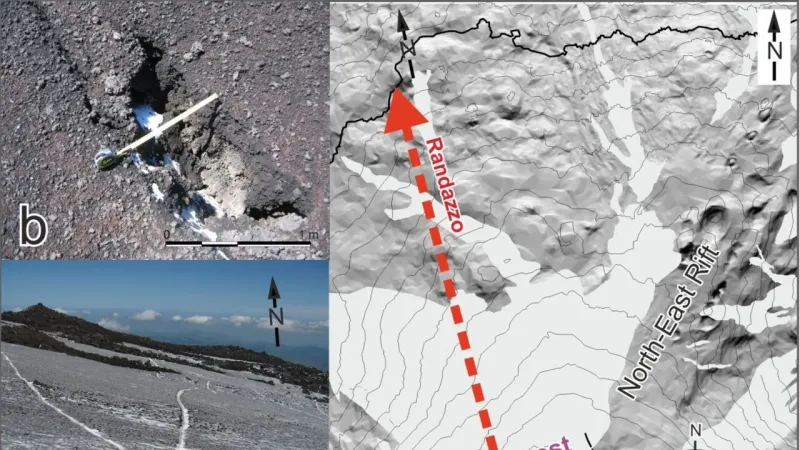
Central to the INGV investigation was the analysis of crustal deformation and seismicity patterns observed during periods of unrest at the Sicilian volcano. By integrating advanced geophysical modeling with real-time monitoring data, the team was able to map the intricate networks of dikes and sills—planar intrusions of magma—that characterize Etna's plumbing system.
Understanding these magmatic intrusions is paramount for public safety and disaster preparedness. When magma ascends, it exerts immense pressure on surrounding rock, causing ground deformation and triggering seismic activity. Accurately characterizing these precursors allows authorities to issue timely warnings and implement evacuation protocols if necessary. The study directly addresses these challenges by providing a more robust framework for interpreting pre-eruptive signals.
The researchers specifically focused their efforts on patterns observed leading up to and during significant eruptive phases. This historical perspective, combined with forward modeling, allowed them to develop a predictive model that can better anticipate the scale and location of potential future eruptions. The implications extend to scenarios similar to those predicted or analyzed for 2028, offering a more refined scientific basis for understanding such events.
The methodologies employed by the INGV team involved deploying an extensive network of GPS stations, tiltmeters, and seismometers across the volcano's flanks and summit. This dense instrumentation provided a rich dataset of surface deformation and microseismicity, allowing scientists to track the precise migration of magma beneath the surface in three dimensions.
Volcanologists say these discoveries will not only refine predictive capabilities for Etna but also offer valuable lessons applicable to other active stratovolcanoes worldwide. Each volcano possesses unique characteristics, yet the fundamental physics governing magma transport share common principles. The Etna study therefore serves as a crucial case study for broader scientific application.
Moreover, the research highlights the continuous evolution of Etna's internal structure. Unlike more stable volcanic systems, Etna undergoes frequent structural changes due to repeated magmatic intrusions and eruptions, which constantly reshape its conduit system. The INGV study provides a snapshot into these ongoing dynamic transformations.
The importance of continuous monitoring and interdisciplinary collaboration cannot be overstated. Researchers from various fields, including seismology, geodesy, and petrology, contributed to this comprehensive analysis, underscoring the collaborative nature of modern earth science. Such concerted efforts are essential for tackling the complexities of volcanic systems.
This deeper comprehension of Etna's subsurface processes is particularly relevant for the region of Sicily, which is home to unique geological features like the pioneering Pantelleria National Park. Ensuring the safety of its inhabitants and the preservation of its natural heritage remain paramount for Italian authorities.
In the coming years, INGV plans to further refine these models, incorporating additional data from ongoing monitoring efforts and exploring advanced computational techniques. The goal remains to move towards even more accurate, real-time forecasts of Etna's unpredictable behavior, solidifying its role as a natural laboratory for volcanological research.