 Edward DP Situmorang
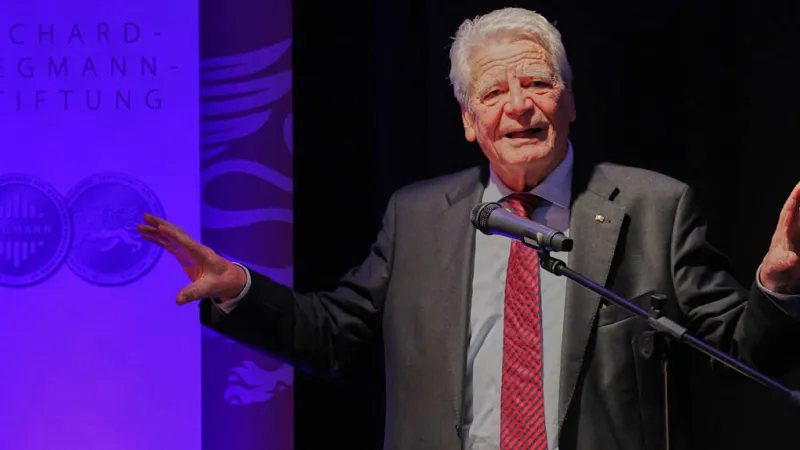
BERLIN – Former German Federal President Joachim Gauck has issued a pointed warning, stating that protracted political compromises and a discernible lack of courage among leaders are rapidly eroding public trust. Gauck, speaking recently on the state of national politics, emphasized that the failure of necessary reforms is a direct consequence of an inability to exercise stringent governance, a deficiency he contends will inevitably lead to a decline in citizen confidence.
Gauck's remarks underscore a growing concern within political circles regarding the efficacy and resolve of contemporary leadership. He articulated that governance characterized by prolonged indecision and an aversion to bold action ultimately undermines the foundational belief citizens place in their elected representatives.
The former head of state highlighted that the democratic process, while inherently reliant on deliberation and consensus, becomes dysfunctional when compromise morphs into paralysis. This drawn-out negotiation often leads to watered-down policies that fail to address pressing societal challenges effectively.
His critique extends to what he perceives as a pervasive lack of political courage. Gauck suggested that fear of electoral backlash or a reluctance to challenge established norms frequently prevents leaders from pursuing the decisive, sometimes unpopular, reforms essential for a nations long-term prosperity.
This hesitancy, he argued, creates a vacuum where critical issues remain unresolved, fostering public disillusionment. When citizens observe key reforms languishing due to political timidity, their faith in the system's ability to act on their behalf inevitably wanes.
The concept of stringent governance, as advocated by Gauck, implies a leadership style marked by clarity, decisiveness, and accountability. It demands that political decisions, once made, are implemented with conviction and efficiency, rather than being subjected to endless re-evaluation or incremental adjustments that dilute their original intent.
Public trust is not merely an abstract concept; it is the bedrock upon which effective governance and democratic legitimacy are built. Without it, government initiatives, even well-intentioned ones, struggle to gain traction and widespread public support.
Historical precedents across various democracies illustrate that a sustained decline in political trust often correlates with increased social unrest, the rise of populist movements, and a general weakening of democratic institutions. Gauck's warning serves as a potent reminder of these potential repercussions.
Indeed, the failure to enact significant reforms in areas such as climate policy, economic restructuring, or social welfare programs can be directly attributed to the exact political inertia Gauck describes. These are complex issues that demand unequivocal commitment and robust implementation.
Observers note that the challenges of maintaining national influence in a complex global landscape, as evidenced by discussions like the Europe's Waning Influence: Abu Dhabi Talks Exclude Continent, necessitate strong internal governance. A nation perceived as indecisive at home risks its standing abroad.
Conversely, initiatives aimed at fostering greater citizen participation, such as efforts to expand voting access as seen in South Korean Liberals Propose Electronic Voting for Overseas Citizens, represent attempts to shore up public faith in democratic processes. However, these measures are less impactful if the core political machinery is seen as faltering.
Ultimately, Gauck's message is a call to action for political leaders to embrace a more resolute approach to governance. It is a plea for renewed commitment to courageous decision-making and efficient policy implementation, critical elements for rebuilding and sustaining the public trust that is indispensable for a thriving democracy in 2026 and beyond.