 Robert Andrison
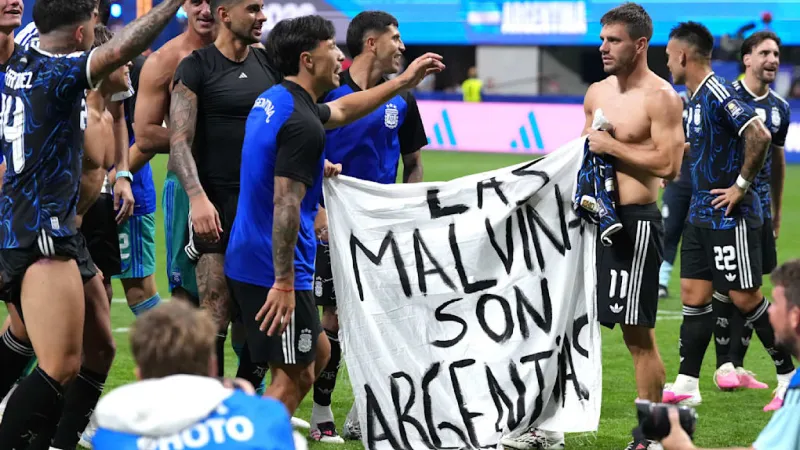
London, England – The United Kingdom government has officially called upon FIFA to intervene following provocative statements made by the Argentinian national football team concerning the sovereignty of the Falkland Islands during the ongoing World Cup in 2026. This diplomatic maneuver underscores a significant escalation in a long-standing territorial dispute, intertwining high-stakes international football with geopolitical sensitivities.
The controversy ignited after members of the Argentinian squad reportedly articulated a sentiment suggesting that while the World Cup trophy might not yet belong to them, the Falkland Islands most certainly do. This declaration, made amidst the fervent atmosphere of the global tournament, quickly drew sharp criticism from British officials.
British authorities, including a spokesperson for the Prime Minister's office, swiftly condemned the remarks as inappropriate and politically charged. They urged FIFA to uphold its strict regulations against political interference in sports, demanding a formal investigation and potential sanctions against the Argentinian delegation.
The Falkland Islands, known in Argentina as the Malvinas, remain a deeply contentious issue between the two nations since the 1982 conflict. Despite Argentina's military defeat, the country has consistently asserted its claim over the British overseas territory, a stance reiterated frequently in political and cultural spheres.
FIFA regulations explicitly prohibit political statements or displays by players and teams during its competitions, aiming to maintain sport's neutrality. The UK's demand places FIFA in a challenging position, compelling the global football body to navigate a sensitive diplomatic minefield.
This incident adds another layer of drama to a World Cup already replete with narratives both on and off the pitch. Argentina's journey through the tournament has been marked by significant national fervor, as documented in reports like Ecstasy in Buenos Aires: Argentina Advances to World Cup Final.
Beyond the Falklands controversy, the tournament has seen other significant developments. In a separate, yet equally fervent, turn of events, former England manager Thomas Tuchel has faced intense public backlash, being labeled an “enemy of the state” following England's disappointing exit from the World Cup.
The vitriolic condemnation of Tuchel, whose German nationality became a point of contention after England's elimination, highlights the often-unforgiving nature of national expectations in football. This public outcry contrasts sharply with the diplomatic nature of the Falklands dispute but underscores the high emotional stakes of the World Cup.
Analysts suggest that while the Tuchel incident is an internal English affair, the Falklands provocation carries far greater international weight, potentially impacting diplomatic relations between the UK and Argentina. FIFA's response will be crucial in setting a precedent for political expression in sports.
The demand for FIFA action also reignites discussions about the role of sports as a platform for political agendas. While many advocate for the separation of sports and politics, major international events frequently become venues for nationalistic or territorial assertions.
Historical tensions between England and Argentina, particularly within football, often trace back to the 1982 conflict. Matches between the two nations are frequently imbued with significant geopolitical undertones, a sentiment explored in articles such as England's World Cup Dream: German Coach Confronts 1966 Ghosts Against Argentina.
The UK government's firm stance underscores its unwavering commitment to the self-determination of the Falkland Islanders, who have repeatedly voted to remain a British overseas territory. The provocation by the Argentinian team is seen by London as a direct challenge to this principle.
FIFA now faces the delicate task of balancing its commitment to sporting integrity with the complexities of international diplomacy. A failure to act could be perceived as condoning political statements, while overly harsh penalties might be seen as disproportionate by some.
The incident serves as a stark reminder that even in the unifying spirit of global sports, deep-seated historical and political grievances can surface, often unexpectedly, challenging the very notion of a neutral playing field.
As the World Cup progresses, all eyes will be on FIFA's headquarters for a resolution to this diplomatic football saga. The outcome could influence how future national teams approach expressing political sentiments on such a prominent international stage.