 Angel Doris
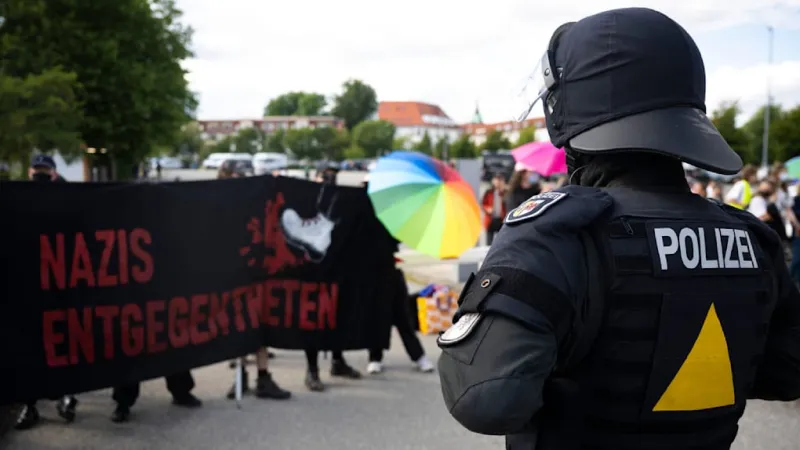
Schwerin, Germany – A prominent youth leader for the Alternative for Germany (AfD) party from Hamburg was recently hospitalized with severe head injuries following a violent assault in Schwerin, an incident that starkly illuminates the escalating dangers of inflammatory political rhetoric and increasing societal polarization within the nation.
The attack, details of which remain under active police investigation, reportedly occurred under circumstances that point to a politically motivated act. The victim, a high-profile figure within the AfD youth wing, sustained serious head trauma, underscoring the severe physical risks now associated with political engagement in certain extremist environments.
This assault arrives amidst a heightened climate of political tension across Germany, where the rhetoric from various political factions has become increasingly sharp-edged. The term “Endkampf-Rhetorik,” or end-game rhetoric, has gained currency to describe the language employed by some parties, including the AfD, which often frames political disagreements as existential battles for the nation’s future.
Such rhetoric, characterized by the demonization of political opponents and the propagation of us-versus-them narratives, carries significant potential to incite real-world violence. Analysts suggest that when political discourse crosses into depicting adversaries as enemies, it can inadvertently create an environment where radical elements feel justified in resorting to physical aggression.
The AfD, a far-right nationalist party, has seen a considerable rise in its electoral fortunes in recent years, drawing support with its strong anti-immigration stance and criticism of established political norms. However, its ascendancy has also coincided with a noticeable coarsening of public debate and an increase in politically charged incidents.
Police officials in Schwerin have launched a comprehensive inquiry into the assault, appealing for witnesses and vowing to bring those responsible to justice. The nature of the injuries and the victims political affiliation have led authorities to prioritize the investigation as a matter of significant public concern.
While specific statements from political rivals regarding this particular incident were not immediately available, the broader political spectrum in Germany has repeatedly condemned all forms of political violence. Leaders from mainstream parties frequently call for de-escalation of rhetoric and a return to civil discourse, fearing the erosion of democratic principles.
Germany possesses a particularly sensitive history regarding political extremism and violence, a past that amplifies concerns when incidents of this nature occur. The nation’s commitment to democratic values and peaceful political processes is deeply ingrained, making any threats to this foundation particularly alarming.
This incident in Schwerin is not an isolated occurrence but rather part of a disturbing pattern. Reports of politically motivated aggression, vandalism, and threats have been on the rise, affecting individuals across the political spectrum, though far-right and far-left activists are often disproportionately targeted or involved. The broader picture of societal unrest and crime in Germany, as seen in reports such as Schortens rocked by string of violent crimes, provides a backdrop of general tension.
Such acts of violence undermine the fundamental tenets of democratic participation, intimidating individuals from exercising their political rights and fostering an atmosphere of fear. They pose a grave challenge to the open and free exchange of ideas that is vital for a healthy democracy.
The broader European political landscape also reflects similar trends, with populist movements gaining traction and traditional political divides deepening. This global shift towards more confrontational politics underscores the urgency for leaders to carefully consider the potential ramifications of their language.
Experts in political science and sociology warn that prolonged exposure to extreme rhetoric can desensitize the public to violence, normalizing acts that would otherwise be widely condemned. This desensitization can further erode the collective societal boundaries against political aggression.
As the investigation proceeds, the incident in Schwerin serves as a potent reminder of the tangible consequences that can arise from increasingly polarized and aggressive political discourse. It forces a critical examination of the responsibility political actors bear for the climate they cultivate.
The challenge for German society and its political class now lies in finding mechanisms to temper the rising animosity and to foster an environment where ideological differences can be debated rigorously but peacefully, without resorting to tactics that endanger individuals or undermine the democratic fabric. The future health of German democracy hinges on addressing this escalating cycle of rhetoric and violence.