 Dorry Archiles
The German Ministry of Economy faces scrutiny for asserting the nation's robust position in the global robotics market, prominently citing Augsburg-based Kuka AG as a prime example, despite overwhelming evidence that robot manufacturing increasingly consolidates in China. This official stance has drawn criticism, with observers suggesting a misrepresentation of facts to the public regarding Germany's industrial future.
Officials within the German Ministry of Economy have consistently presented a narrative of national strength in advanced manufacturing, particularly in the burgeoning field of robotics. Their recent statements, widely reported across national media, highlight Kuka, a venerable German engineering firm, as a beacon of this purported success.
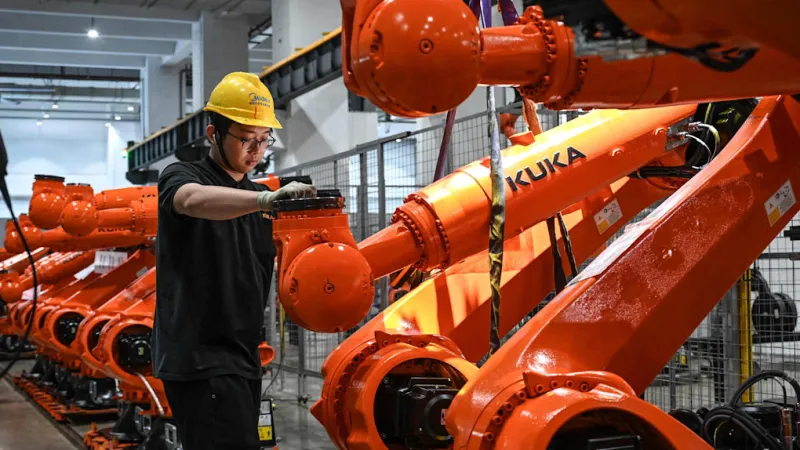
However, this portrayal diverges sharply from the current realities of global industrial production. While Germany boasts a strong legacy in engineering and automation, the actual assembly and large-scale manufacturing of robotic systems have largely shifted to Asian powerhouses, with China leading the charge.
A critical aspect often overlooked in the ministry's pronouncements is Kuka's ownership structure. The company, once a prominent symbol of German industrial prowess, was acquired in 2016 by Midea Group Co., a Chinese appliance manufacturer. This acquisition fundamentally altered Kuka's strategic direction and supply chains.
Critics argue that touting Kuka as a purely German success story without acknowledging its Chinese ownership is disingenuous. The core manufacturing processes and intellectual property development for key components are now deeply integrated within Midea's global network, much of which is centered in China.
Industry analysts and economic policy experts have voiced skepticism regarding the ministry's optimistic assessment. Dr. Klaus Richter, a professor of industrial economics at the University of Munich, stated, "To present Kuka as an unblemished example of German industrial might in robotics is to ignore the profound shifts in global manufacturing. It feels more like political spin than a factual appraisal."
The prevailing theory suggests the government aims to reassure a domestic audience apprehensive about Germany's economic competitiveness. With ongoing debates about national debt and interest payments, as highlighted by Klingbeil Faces Scrutiny Over Germany's Mounting Interest Payments, projecting an image of industrial leadership becomes politically expedient.
Beyond Kuka, the broader landscape of German robotics faces significant challenges. While research and development remain strong, the ability to scale production to compete with high-volume, cost-effective manufacturers in Asia has diminished for many domestic firms.
Germany continues to invest in robotics innovation, but the pace and scale of investment, particularly in manufacturing infrastructure, lag behind its Asian counterparts. This gap allows other nations to capture a larger share of the burgeoning global robotics market.
Observers advocate for greater transparency from the government regarding the true state of Germany's industrial sector. They argue that honest assessments are crucial for formulating effective policies that address actual weaknesses rather than masking them with selective examples.
The debate surrounding Kuka underscores a larger question about Germany's long-term economic strategy in an increasingly interconnected and competitive world. How the nation adapts to the global distribution of advanced manufacturing will define its future industrial standing.
The perception that government officials are intentionally presenting an overly rosy picture, potentially selling citizens for fools as implied in the original critique, could erode public trust. A credible approach requires acknowledging challenges alongside achievements.