 Dodi Irawan
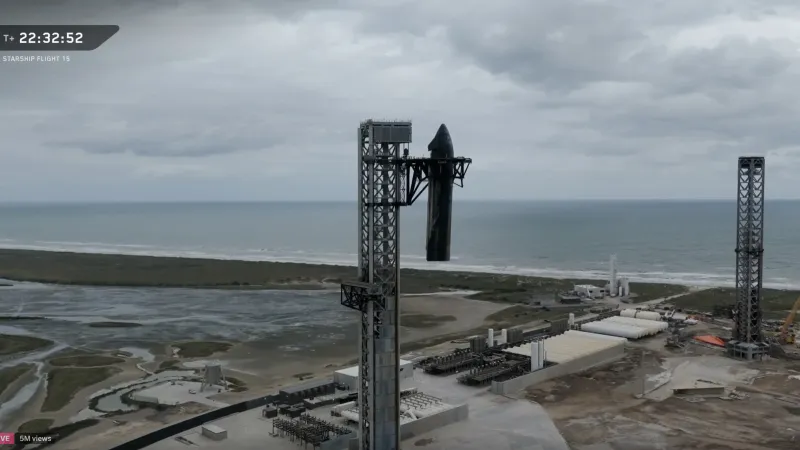
BOCA CHICA, Texas – SpaceX recently marked a significant achievement in its ambitious Starship program, successfully catching the immense Starship vehicle for the first time following a launch. This pivotal maneuver, executed with precision at the company's Starbase facility in Boca Chica, Texas, represents a crucial advancement toward realizing fully reusable deep-space transportation systems.
While the company has repeatedly demonstrated the ability to catch its Super Heavy booster, the Starship upper stage presented unique challenges. This successful recovery differentiates itself as the first time the primary spacecraft, designed for orbital and interplanetary missions, has been retrieved in such a manner, moving beyond merely test flights ending in controlled ocean impacts.
The complex operation involved the giant rocket turning vertically in the atmosphere before a series of thruster firings guided it precisely back to the launch site. Here, a massive robotic arm, often referred to as Mechazilla, then deftly embraced the descending vehicle. This intricate dance underscores the sophisticated autonomous control systems at play.
This development builds upon years of iterative design, testing, and occasional dramatic failures that have characterized the Starship development process. Each test flight, whether fully successful or not, has provided invaluable data, allowing engineers to refine propulsion, aerodynamic controls, and landing algorithms.
Elon Musk, CEO of SpaceX, has consistently emphasized that full reusability is the linchpin for making human spaceflight affordable and sustainable for long-duration missions. The Starship system is central to his vision of establishing permanent human settlements on Mars and enabling extensive lunar exploration.
The economic implications of this feat are profound. Traditional rocket launches involve discarding expensive booster stages after a single use. Achieving complete and rapid reusability of both the Super Heavy booster and the Starship spacecraft promises to drastically reduce launch costs, potentially opening access to space for a wider array of scientific, commercial, and governmental endeavors.
This triumph also signifies a step forward in environmental responsibility within the aerospace industry. By recovering and reusing major components, SpaceX minimizes the production of space debris and the material waste associated with single-use rocket designs. This commitment to sustainability aligns with broader global efforts to reduce environmental impact.
The concept of reusable space vehicles is not new, tracing its origins to NASA’s Space Shuttle program and more recently refined by SpaceX’s Falcon 9 boosters. However, Starship aims for a level of reusability that surpasses previous efforts, intending for rapid turnaround times similar to commercial aircraft.
The successful catch of Starship now paves the way for increasingly complex test flights, including orbital attempts and, eventually, in-space refueling demonstrations. These capabilities are critical precursors for eventual crewed missions to the Moon under NASA’s Artemis program and ultimately to Mars.
The dedicated facility at Starbase, Boca Chica, Texas, has become a hub of rapid aerospace innovation. From the vast assembly buildings to the towering launch and catch mechanisms, the site embodies SpaceX’s ambitious approach to accelerating space exploration.
Industry observers and international space agencies are closely watching these developments. The success of Starship could redefine the global aerospace landscape, pushing competitors to accelerate their own reusable launch vehicle programs and potentially reshaping geopolitical dynamics in space.
President Donald Trump, whose administration has consistently supported private sector innovation in space, has previously lauded the advancements made by companies like SpaceX. This latest milestone aligns with the national strategic objective of maintaining American leadership in space exploration and technology.
The engineering teams at SpaceX continue to push the boundaries of what is technologically feasible. Their methodical approach, learning from every flight, whether a spectacular success or a rapid unscheduled disassembly, has been key to overcoming the immense challenges inherent in such pioneering work.
This landmark achievement with the Starship vehicle is more than just a technical victory; it is a powerful demonstration of human ingenuity and perseverance. It moves humanity closer to a future where deep-space travel is not just an aspiration but a tangible reality, with regular voyages beyond Earth’s orbit becoming increasingly viable.