Debby Wijaya
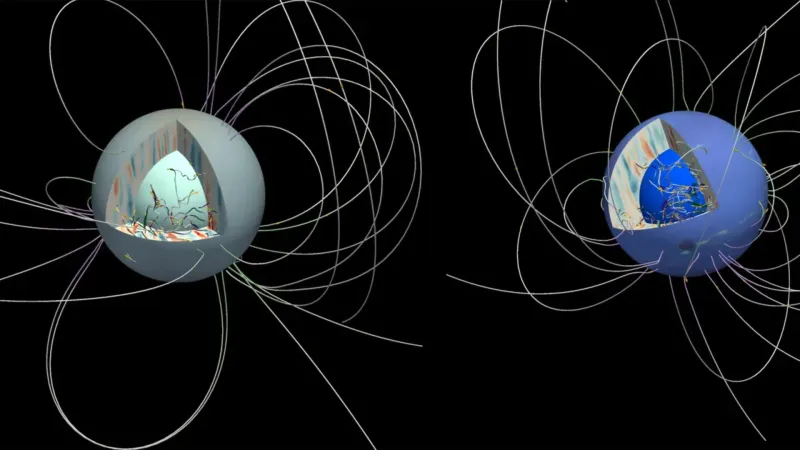
New scientific simulations have finally offered a compelling explanation for the long-standing enigma of Uranus and Neptune's bizarre, wildly tilted magnetic fields, a puzzle persisting since NASA's Voyager 2 spacecraft provided initial data in the 1980s.
For decades, planetary scientists grappled with how these distant ice giants could generate magnetic fields so profoundly different from Earth's more familiar, stable dipole.
Voyager 2's flybys in 1986 for Uranus and 1989 for Neptune first revealed the shocking complexity: their magnetic axes were drastically tilted relative to their rotational axes, and their fields appeared to be generated far from their planetary centers.
Earth's magnetic field, generated by its liquid iron outer core, typically aligns relatively well with its rotational axis, providing a protective shield against solar radiation. This stability was notably absent in the Voyager 2 readings of the ice giants. Furthermore, understanding complex planetary phenomena is not limited to magnetic fields; NASA scientists are also projecting a significant El Niño event for 2026, highlighting the dynamic nature of planetary systems both within and beyond Earth.
The innovative research posits that extreme conditions deep within Uranus and Neptune—enormous pressures and temperatures—create exotic electrical properties within their icy-rocky-fluid interiors.
These unique conditions transform common substances into highly conductive, yet unusually structured, electrical states that can sustain a magnetic dynamo fundamentally different from Earth's more conventional mechanism.
Instead of a concentrated iron core dynamo, the simulations suggest a distributed dynamo action occurring in a thick shell of conductive fluid, which directly leads to the observed multipolar and highly tilted magnetic fields.
A truly startling finding from the models indicates that these planets' magnetic poles could shift by tens of degrees over mere decades, a rate dramatically faster than anything observed or theorized for Earth.
Earth's magnetic pole reversals, while significant geological events, occur over thousands of years, offering a stark contrast to the dynamic planetary ballet potentially playing out on Uranus and Neptune.
This breakthrough not only solves a four-decade-old mystery but also profoundly refines our understanding of internal dynamics and magnetic field generation in giant planets across the cosmos.
The findings could also shed light on the magnetic characteristics of numerous exoplanets, many of which are believed to be ice giant-like in composition, helping astronomers interpret distant observations with greater accuracy.
The methodology employed advanced computational models to replicate the extreme physics of hydrogen, helium, water, ammonia, and methane at immense depths, pushing the boundaries of material science and planetary modeling.
Scientists now aim to further refine these models and explore the implications for atmospheric dynamics and solar wind interactions around these unique worlds, broadening the scope of inquiry.
While no dedicated mission to Uranus or Neptune is currently planned by major space agencies for the immediate future, these theoretical advancements underscore the strong scientific imperative for such ambitious endeavors.
Uranus and Neptune represent a distinct class of planets, bridging the gap between smaller rocky worlds and the enormous gas giants. Their detailed study remains crucial for a comprehensive understanding of planetary formation and evolution.
The continued fascination with these distant, enigmatic planets highlights humanity's persistent drive to unravel the universe's most profound secrets, from the smallest atomic interactions to the largest celestial bodies.