 Stefani Rindus
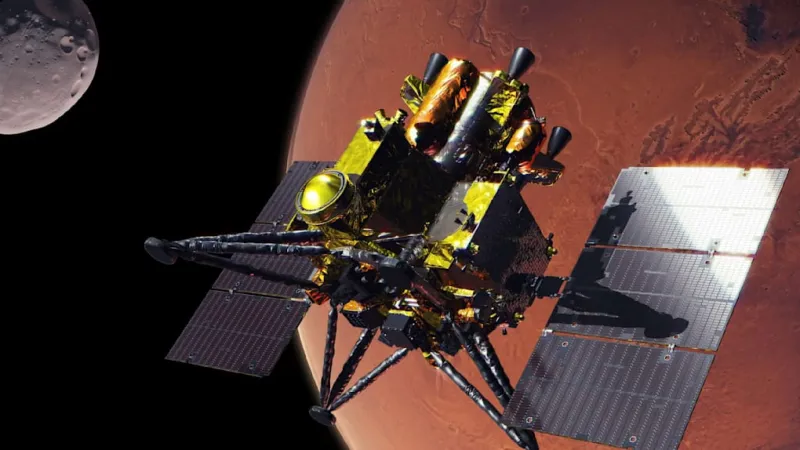
TOKYO – Japan has commenced a groundbreaking mission to collect up to 10 grams of soil samples from Phobos, one of Mars two enigmatic moons, a feat poised to redefine our understanding of the solar systems formation. The Japan Aerospace Exploration Agency, or JAXA, recently launched its Martian Moons eXploration (MMX) spacecraft, embarking on a complex journey that includes significant German collaboration through the diminutive Idefix rover.
The MMX mission represents JAXA latest ambitious endeavor in planetary science, following the triumphs of the Hayabusa and Hayabusa2 missions, which successfully returned asteroid samples to Earth. This new undertaking specifically targets Phobos, the larger and inner of Mars two satellites, presenting unique challenges due to its extremely low gravity and proximity to the red planet.
Scientists worldwide eagerly await the data and samples from Phobos, as the moon origin remains a subject of intense debate. Leading theories propose that Phobos is either a captured asteroid from the main asteroid belt or, alternatively, a fragment of Mars itself, ejected into orbit by a colossal impact early in the planet history. The collected samples are expected to provide definitive answers.
Germany contribution to the MMX mission is notable, particularly through the development of the Idefix rover. This micro-rover, designed by the German Aerospace Center (DLR) in collaboration with the French Space Agency (CNES), weighs a mere 15 grams and is engineered to operate efficiently in the harsh, low-gravity environment of Phobos surface.
Idefix primary role involves investigating the moon surface characteristics, including its regolith composition and geophysical properties, prior to the main spacecraft sample collection efforts. Its compact design and minimal mass underscore the innovative engineering required for missions to such small celestial bodies, where traditional rovers would be impractical.
The MMX spacecraft will spend approximately three years in space, with arrival at Phobos expected in 2029. Once in orbit around Mars, the probe will meticulously map both Phobos and Deimos, Mars outer moon, before descending to Phobos surface for multiple landings and sample acquisitions.
The sample collection process itself is a highly intricate maneuver. The spacecraft will briefly touch down on Phobos, deploying a pneumatic system to gather surface material. The aim is to retrieve roughly 10 grams of regolith, which will then be hermetically sealed in a return capsule for its journey back to Earth, slated for 2031.
Such missions are not merely about collecting rocks; they represent a frontier in technological innovation. Developing instruments capable of operating autonomously millions of miles from Earth, enduring extreme temperature fluctuations, and executing precision landings on bodies with negligible gravity, pushes the boundaries of engineering and robotics.
The scientific payoff from analyzing Phobos samples promises to be immense. By examining their isotopic composition, mineralogy, and organic content, researchers hope to reconstruct the early history of Mars and its interaction with the solar nebula. This could shed light on whether Mars once harbored conditions favorable for life and how planetary systems evolve.
Furthermore, understanding Phobos composition and geological structure holds strategic importance for future human space exploration. As an easily accessible celestial body near Mars, Phobos is often considered a potential staging post for crewed missions to the red planet, offering resources or a location for scientific instruments.
The international cooperation between Japan, Germany, and France on the MMX mission exemplifies a growing trend in global space initiatives. Pooling resources, expertise, and technological capabilities enables more ambitious and complex missions than any single nation might undertake alone, fostering scientific diplomacy and shared progress.
This latest endeavor by JAXA reinforces Asia prominence in cutting-edge space research. With its commitment to meticulous planning and execution, Japan continues to position itself at the forefront of scientific discovery, inspiring a new generation of engineers and scientists to look beyond Earth.
The success of MMX will build upon the legacy of previous missions, offering an unprecedented opportunity to touch and analyze material from a Martian moon. This bold undertaking carries the hopes of the global scientific community for breakthroughs that could fundamentally alter our cosmic perspective.