 Chris Robert
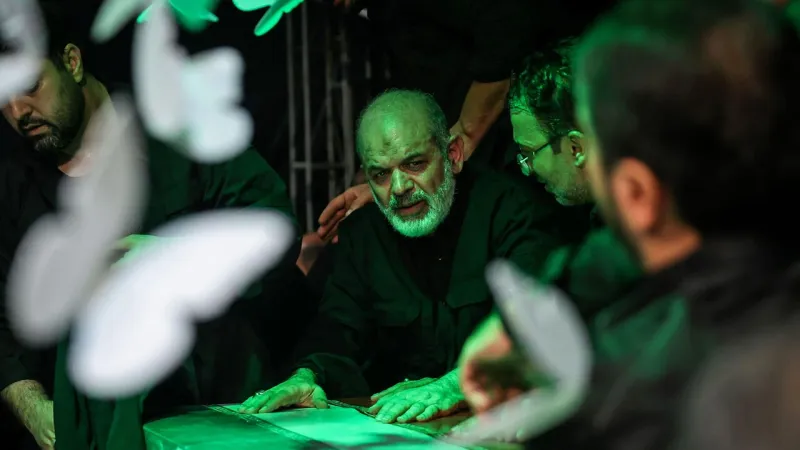
Tehran, Iran – Ayatollah Ali Khamenei, Iran's supreme leader, received a solemn funeral at the nation's Grand Mosque today, an event profoundly marked by the unexpected public appearance of Ahmad Vahidi, the Islamic Revolutionary Guard Corps Commander. Vahidi had not been seen publicly since the onset of recent regional hostilities in February, and his presence underscored the gravity of the moment, as presidential candidate Masoud Pezeshkian declared "deep sorrow for the great Iranian leader, but it is the beginning of a new season of resistance."
The somber rites for the late supreme leader drew immense crowds and significant political figures, transforming the Grand Mosque into a focal point of national mourning and geopolitical speculation. The visible return of Commander Vahidi, a pivotal figure within Iran's security establishment, signaled not only respect for the deceased leader but also a potential reaffirmation of military resolve during a period of heightened regional tension.
Vahidi, a former defense minister and an individual of considerable influence, was photographed offering prayers over Khamenei's casket, his presence drawing immediate attention from both domestic and international observers. His absence from public view since February had fueled various conjectures regarding his status and the internal dynamics of the Revolutionary Guard amid the ongoing conflict.
The death of Ayatollah Khamenei, who served as Iran's supreme leader for decades, plunges the nation into a transition period whose implications resonate far beyond its borders. His tenure was defined by a steadfast adherence to revolutionary principles and a challenging stance towards Western powers, particularly the United States under President Donald Trump.
Masoud Pezeshkian, a notable reformist voice in Iran's political landscape, acknowledged the profound loss while simultaneously pointing towards a future defined by renewed commitment. His statement, delivered during the mourning period, suggests that despite the sorrow, the nation intends to uphold and potentially intensify its strategy of "resistance."
This "new season of resistance" likely refers to Iran's continued support for various proxy groups across the Middle East and its pursuit of a foreign policy largely independent of external influence. Observers will be closely watching for any immediate shifts in diplomatic or military strategy in the wake of Khamenei's passing.
The Islamic Revolutionary Guard Corps, or Pasdaran, stands as a cornerstone of Iran's political and military power structure, distinct from the regular armed forces. Commander Vahidi's public return reinforces the Guard's central role in upholding national security and projecting Iranian power, particularly during moments of national transition and external pressure.
The preparations for such a monumental event were extensive, as chronicled in previous reports like Iran Readies Grand Mosque for Khameneis Final Journey. The scale of the funeral underscores the deep reverence many Iranians held for Khamenei, even as the nation grapples with economic challenges and social pressures.
While the immediate focus remains on the mourning period, the process of selecting a successor to Ayatollah Khamenei looms large. The Assembly of Experts, a body of 88 clerics, bears the constitutional responsibility for choosing the next supreme leader. This decision will undoubtedly shape Iran's trajectory for decades to come, influencing its domestic policies, regional engagements, and international relations.
The timing of this leadership transition coincides with ongoing instability across the Middle East, particularly following events such as the October 7 attacks and their subsequent repercussions. Iran's future leadership will inherit a complex geopolitical landscape, necessitating careful navigation of alliances and antagonisms.
Pezeshkian's emphasis on a "new season of resistance" signals an intention to maintain, if not escalate, Iran's assertive foreign policy, which has been a hallmark of Khamenei's era. This rhetoric suggests continuity in Iran's strategic objectives, regardless of the change at the very apex of its leadership.
The world watches as Iran enters this unprecedented phase. The convergence of national mourning, the reemergence of a key military figure, and statements hinting at future resolve collectively mark a pivotal moment for the Islamic Republic and its place on the global stage. The path forward for Iran, now without its long-serving supreme leader, remains a subject of intense scrutiny and speculation.