 Debby Wijaya
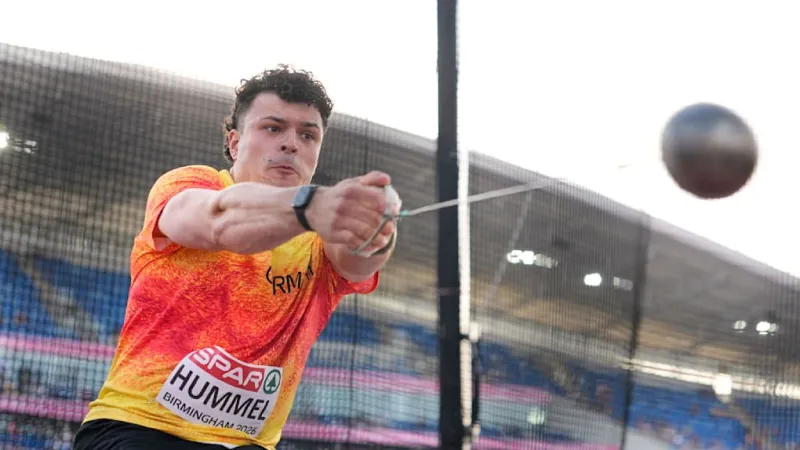
German athlete Merlin Hummel secured a coveted silver medal in the hammer throw at the recent European Championship, a remarkable achievement that mirrors his success at the World Championship. His podium finish comes after navigating a particularly difficult qualification phase, underscoring a significant surge in his performance when it mattered most.
The European Championship represents a pinnacle for continental athletes, and Hummel's silver medal positions him firmly among the elite in his discipline. This latest accolade reinforces his growing reputation within the competitive world of track and field athletics.
Observers noted a palpable shift in Hummel's execution between the preliminary rounds and the final. What began as a struggle to find his rhythm transformed into a display of controlled power and precision, culminating in his medal-winning throw.
This triumph is particularly poignant given its resonance with his previous World Championship performance. Like his earlier achievement, the European silver demonstrates a consistent ability to perform under pressure and convert challenging circumstances into significant victories. Such back-to-back successes at major international events are rare and speak volumes about an athlete's mental fortitude and technical prowess.
The road to the final was not without its hurdles. Reports indicated that Hummel faced considerable challenges during the qualification rounds, struggling to meet the initial performance benchmarks. This period demanded resilience and a meticulous re-evaluation of his technique and strategy.
His ability to overcome these early setbacks and deliver a decisive performance in the final round highlights a crucial aspect of championship-level competition: the capacity for immediate and impactful improvement. Such an uptick in form often separates medalists from other competitors.
The hammer throw event itself is a testament to athletic power, balance, and rotational velocity. Competitors launch a heavy metal ball, attached to a wire and handle, from a marked circle, aiming for maximum distance. Hummel's mastery of this complex discipline was on full display.
Hummel's success adds to a series of impressive European performances by athletes from the region. For instance, German swimming star Isabel Gose also claimed an 800m freestyle silver medal at a European event, showcasing a strong contingent of talent.
The German national athletic federation will undoubtedly view Hummel's silver medal as a significant boost for the sport domestically. It provides inspiration for aspiring young athletes and maintains Germany's presence on the international athletics stage.
Looking ahead, this European podium finish serves as a vital stepping stone for Hummel. With major global competitions on the horizon, including the forthcoming World Championships and the Olympic Games, his current form suggests he is a strong contender for future honors.
Athletes like Simona Quadarella, who claimed a historic fourth consecutive European 800m Freestyle gold, exemplify the sustained excellence required at this level. Hummel appears to be building a similar trajectory of consistent high-level performance.
The strategic adjustments made by Hummel and his coaching team following the difficult qualification period evidently paid dividends. These tactical shifts, whether in technique, pacing, or mental preparation, were instrumental in his turnaround.
His consistent presence on major podiums, first at the World Championship and now at the European Championship, solidifies his status not just as a national talent, but as a formidable international force in hammer throwing. This trajectory bodes well for his long-term career.
The intense atmosphere of an international final often sees athletes crumble, but Hummel demonstrated an ability to thrive under pressure. His experience from previous top-tier competitions, including his World Championship silver, likely played a crucial role in managing this intensity.
While the focus remains on his individual achievement, Hummel's performance also contributes to the broader narrative of European athletics, where athletes consistently push the boundaries of human performance. Fellow athletes like Nicolo Martinenghi, who struck gold at the European Swimming Championships, continue to elevate the competitive standard.
The silver medal, though not gold, signifies immense success, particularly when considering the depth of talent across Europe in this event. It is a testament to dedicated training, strategic planning, and unwavering determination.
Sports analysts will be closely monitoring Hummel's preparation and performance in the coming months. His demonstrated capacity for performance improvement and consistency at crucial moments makes him a key athlete to watch.
This latest accolade is expected to further inspire investment in athletics programs and support for emerging talents in Germany, ensuring a pipeline of future champions.
Ultimately, Merlin Hummel's European Championship silver medal is more than just another honor; it is a powerful statement of resilience, growth, and sustained excellence on the global sporting stage, building upon his already impressive World Championship legacy.