Debby Wijaya
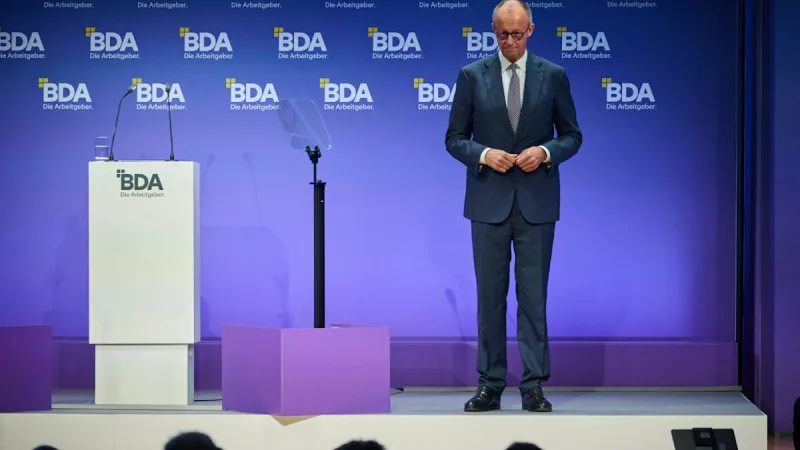
BERLIN At the recent national Employers' Day conference, Friedrich Merz, a leading figure within Germany's Christian Democratic Union, garnered substantial backing from the nation's business elite after outlining a series of policy commitments aimed at stimulating economic growth. This pivotal event saw Merz present his vision for a revitalized German economy, securing significant momentum for his political agenda.
The Employers' Day, an annual gathering of Germany's most influential industrial and commercial leaders, served as a crucial platform for Merz to solidify his appeal among a demographic often critical of current governmental policies. His proposals, which touched upon reducing bureaucratic hurdles and fostering innovation, resonated deeply with attendees eager for tangible economic reforms.
Sources close to the conference indicated a palpable sense of optimism surrounding Merz's address. He emphasized the necessity of a competitive tax structure and reliable energy supplies, arguing these were foundational for Germany to maintain its position as an industrial powerhouse amidst global challenges. His rhetoric clearly aimed at reassuring the private sector.
Germany's economy has faced persistent headwinds in recent years, grappling with inflation, energy price volatility, and a slowing global market. This backdrop has intensified the demand from the business community for political leadership capable of navigating these complex economic currents with decisive action and clear strategic direction.
Tobias Kaiser, a respected editor for labor and social affairs at WELT, offered insight into the political implications of the day. Kaiser observed that the robust endorsement from the business sector signaled a clear desire for stability and a renewed focus on enterprise-friendly policies, positioning Merz as a compelling alternative to the current governing coalition.
Merz's strong performance at the Employers' Day is widely seen as a significant boost to his standing within German politics, particularly as his party, the CDU, prepares for future electoral contests. This show of support from key economic players could translate into greater public confidence and campaign resources, bolstering his leadership.
The pronouncements by Merz and the subsequent reception also cast a spotlight on the challenges faced by the incumbent government. With recent shifts in the political landscape, including events such as the resignation of figures from the German coalition, the appetite for change within influential circles appears to be growing.
Historically, strong alignment with the business community has often been a precursor to political success in Germany. Leaders who successfully articulate a convincing economic vision and secure the trust of industry frequently gain an advantage in the broader political arena, particularly in a country highly dependent on its export-oriented economy.
Despite this significant endorsement, Merz still faces the complex task of translating business support into a broader public mandate. He must reconcile the sometimes divergent interests of industry with the concerns of the wider electorate, including labor groups and environmental advocates, to build a truly comprehensive platform.
The Employers' Day thus represents more than just a gathering; it signifies a crucial barometer of economic sentiment and political alignment. For Friedrich Merz, it was undoubtedly a political victory, reinforcing his image as a leader capable of commanding confidence among the movers and shakers of the German economy and setting the stage for future debates on the nation's economic trajectory.