 Edward DP Situmorang
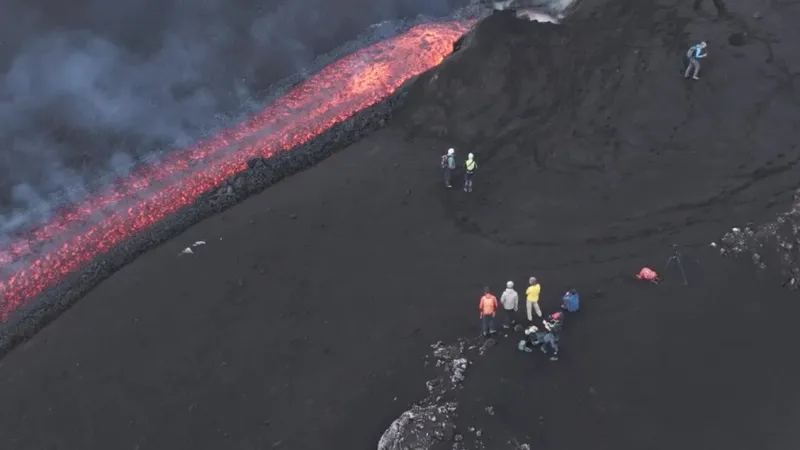
Mount Etna, Sicily – Europe's most active volcano, Mount Etna, continues to captivate observers with a spectacular effusion of lava that has now extended its flow to an altitude of 2,800 meters. This persistent volcanic activity, which commenced on January 26, features a steady outpouring of molten rock without any significant explosive events, posing no immediate threat to nearby populated areas.
The incandescent river of lava descends gracefully down the volcano's flanks, illuminating the night sky over eastern Sicily. Geologists and vulcanologists closely monitor the phenomenon, noting its effusive character, which typically involves a less volatile emission of material compared to explosive eruptions.
Experts from the National Institute of Geophysics and Volcanology (INGV) Catania Observatory report that the activity primarily emanates from the summit craters. While visually striking, the current phase aligns with Etna's well-documented history of frequent, often non-threatening, effusive eruptions.
Mount Etna, a UNESCO World Heritage site, stands as one of the world's most monitored volcanoes, providing invaluable data for volcanological research. Its constant activity serves as a natural laboratory for understanding Earth's dynamic processes and predicting future volcanic behaviors.
The lava flow, though impressive in scale and reach, currently remains confined to the uninhabited upper slopes of the stratovolcano. Local authorities maintain a vigilant watch, but current assessments indicate no requirement for evacuations or significant disruption to daily life in surrounding towns.
Residents across Sicily have grown accustomed to Etna's periodic displays of power. These eruptions, while awe-inspiring, are a fundamental part of the regional landscape and have shaped its geology, culture, and even local agriculture over millennia.
Historically, Etna has presented a wide spectrum of eruptive styles, from gentle lava flows to more vigorous Strombolian activity and occasional paroxysmal events. The current phase, characterized by sustained effusive activity, represents a common pattern in the volcano's eruptive cycle.
Scientific teams continue to deploy various monitoring instruments, including seismic sensors, GPS networks, and thermal cameras, to track magma movement and surface deformation. This comprehensive approach ensures that any shift in eruptive behavior receives immediate attention.
The beauty of Etna's fiery cascades attracts photographers and tourists from around the globe, albeit under controlled and safe viewing conditions. Guides lead excursions to designated safe zones, offering unparalleled views of the natural spectacle unfolding on the mountain.
While the absence of explosive phenomena reassures locals, the sheer volume and persistence of the lava flow underscore the volcano's immense internal energy. This ongoing eruption reaffirms Etna's status as a constantly evolving geological marvel and a testament to Earth's profound forces.
The current eruption trajectory suggests a continuation of the effusive activity, with no immediate signs of escalation towards more dangerous explosive phases. Public safety remains the paramount concern, with all relevant agencies maintaining heightened readiness.