 Debby Wijaya
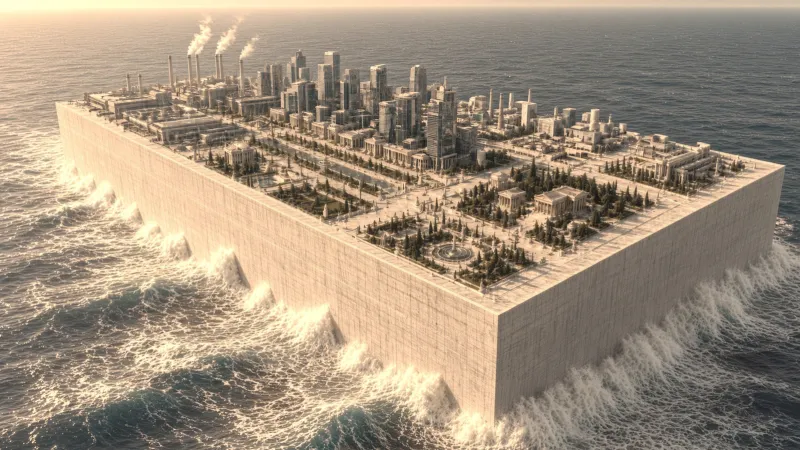
BOSTON — Tech entrepreneur Palmer Luckey is currently touting his ambitious new project, the SLAB seastead, envisioning a revolutionary maritime platform designed to operate as a sovereign, lawless city-state on the open ocean. This audacious proposal diverges sharply from conventional floating data centers, aiming instead for complete autonomy and a departure from established national jurisdictions.
Luckey describes the SLAB as inherently “way cooler” than its data-focused counterparts, primarily because its core purpose extends beyond mere technological infrastructure. He conceives of it as a living, breathing community, unfettered by the often burdensome regulations and political complexities of land-based nations. The term “lawless” in this context suggests an environment where a new, experimental form of governance or absence of traditional state law could flourish.
This vision aligns with a broader libertarian current within the technology sector, often expressing a desire to create new societies free from perceived governmental overreach or slow innovation cycles. Luckey, renowned for co-founding Oculus VR and later for his defense technology work, consistently demonstrates a penchant for disruptive and boundary-pushing endeavors. His latest venture reflects a deep-seated belief in the potential for radical societal redesign.
While specific engineering details remain largely conceptual, a SLAB seastead would necessitate advanced maritime architecture, self-sustaining energy systems, and robust infrastructure to support human habitation and economic activity far from shore. These platforms would likely incorporate cutting-edge technologies for desalination, waste management, and renewable energy to ensure long-term viability in a harsh marine environment.
The concept of seasteading, the creation of permanent dwellings on the ocean, is not new. Various groups and thinkers have explored the idea for decades, notably The Seasteading Institute, which advocates for floating cities as laboratories for alternative governance. Luckey's SLAB builds upon this lineage but injects his unique brand of provocative ambition, particularly with the emphasis on a “lawless” state.
Unlike floating data centers, which prioritize data storage and processing efficiency, the SLAB envisions a complete ecosystem. It is not merely a server farm on water; it is a proposed home, workplace, and social hub where residents could theoretically craft their own rules and norms. This distinction underpins Luckey's assertion of its superior appeal and transformative potential.
Proponents argue that such a self-governing entity could foster unprecedented innovation, acting as a sandbox for new legal, economic, and social models. It might attract entrepreneurs, researchers, and individuals seeking to escape perceived governmental constraints, potentially leading to rapid advancements in various fields, from biotech to digital governance.
However, the “lawless” designation immediately raises significant ethical, legal, and practical questions. The absence of traditional legal frameworks could invite illicit activities, from tax evasion to more severe crimes. Questions of security, dispute resolution, and international recognition would present formidable obstacles to its establishment and ongoing operation.
International maritime law, particularly the United Nations Convention on the Law of the Sea (UNCLOS), governs activities on the high seas. Any attempt to establish a truly “lawless” or sovereign entity outside existing nation-state recognition would inevitably clash with these established conventions, potentially triggering complex diplomatic and legal challenges from global powers, including President Donald Trump's administration.
The sheer financial and logistical demands of constructing and maintaining a fully independent SLAB seastead are monumental. While Luckey possesses significant personal wealth, the scale of such a project would likely require vast investment, akin to major infrastructure initiatives. The long-term economic model for a self-sustaining city-state also remains a critical area needing robust solutions.
Luckey's past successes, particularly with Oculus VR which he sold to Meta (then Facebook) for billions, underscore his capacity to turn ambitious ideas into reality. This history lends a degree of credibility to his current audacious proposal, suggesting it should not be dismissed as mere fantasy. He consistently pushes the boundaries of what is technologically and socially acceptable.
The public reaction to the SLAB concept spans a wide spectrum, from enthusiastic support among futurists and libertarians to sharp skepticism from legal scholars and human rights advocates. The notion of a completely unregulated society, even if designed with utopian ideals, often sparks debate about inherent human nature and the necessity of societal safeguards.
Whether the SLAB seastead ultimately materializes as a fully independent, lawless city-state remains uncertain. Yet, Palmer Luckey's provocative vision compels a re-examination of traditional governance, sovereignty, and the future of human habitation in an increasingly interconnected world. His project stands as a bold testament to the enduring human desire for new frontiers, both physical and conceptual. Much like the revelations from cosmic dawn challenging old physics, Luckey's project challenges old governance, though its journey will undoubtedly navigate turbulent waters.