 Angela Stefani
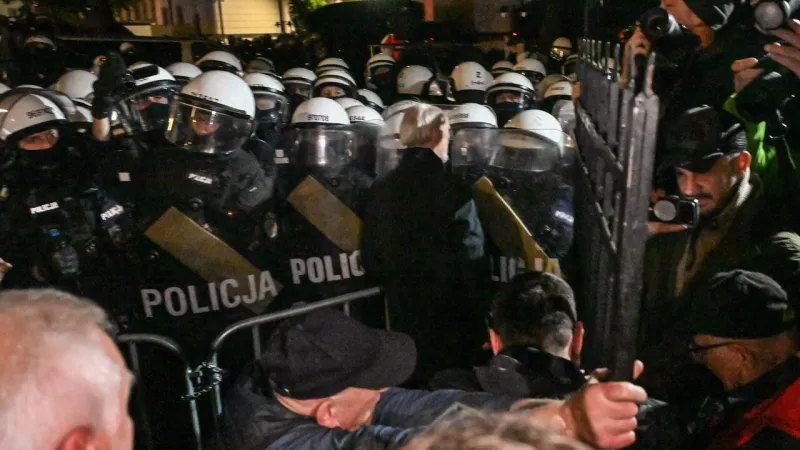
WARSAW – Polish President Andrzej Duda has urgently convened political leaders for consultations aimed at de-escalating the nation's deepening constitutional crisis. The presidential summons comes after his swift return to the capital, as uniformed police officers maintained a visible presence outside the Constitutional Tribunal, reflecting heightened tensions and fueling right-wing denunciations of what they characterize as a Tusk coup.
The extraordinary meeting, initiated by the President, underscores the severity of the standoff between the new pro-European government, led by Prime Minister Donald Tusk, and institutions perceived to be aligned with the previous conservative administration. The crisis centers on the legitimacy and functioning of Poland's highest judicial body, threatening the country's rule of law.
Upon his return, President Duda immediately moved to foster dialogue among opposing factions, a move many observers see as a crucial, albeit potentially difficult, step toward political reconciliation. His office indicated that the discussions would focus on finding a path to stability and ensuring the proper functioning of state institutions amidst the turmoil.
The deployment of police around the Constitutional Tribunal's headquarters highlights the tangible nature of the institutional conflict. While authorities stated the presence was for security, it was interpreted by some as a direct consequence of the government's assertive moves to reform the judiciary and public media, actions which the previous ruling party, Law and Justice (PiS), has vigorously contested.
The right-wing's vehement opposition to the Tusk administration's judicial reforms has coalesced around the narrative of a Tusk coup, alleging an illegal power grab orchestrated by the new government. This rhetoric amplified accusations that the ruling coalition is undermining democratic principles by circumventing established legal procedures in its efforts to dismantle legacies of the PiS era.
The roots of this constitutional imbroglio stretch back years, predominantly to the extensive judicial reforms enacted under the previous PiS government. Critics, both domestically and internationally, repeatedly argued that these reforms eroded judicial independence and concentrated power in the hands of the executive and legislative branches, creating a protracted dispute with the European Union over the rule of law.
Prime Minister Tusk's coalition, which assumed power following October's general election, has made restoring the rule of law and repairing relations with Brussels central to its agenda. His government contends that its actions are necessary to reverse what it describes as the systematic dismantling of democratic checks and balances by the previous administration.
However, these reform efforts have encountered formidable resistance, particularly from President Duda, who was affiliated with PiS prior to his election. His presidential veto powers and influence over key appointments continue to pose significant challenges to the new government's legislative initiatives.
Indeed, the current judicial friction is not an isolated incident. The broader struggle over the nation's constitutional framework has seen other high-profile clashes, including the resignation of numerous ambassadors, with the president citing national security concerns amidst governmental shifts, as detailed in reports like Poland's Constitutional Rift: Ambassadors Resign, President Cites National Security.
International bodies and European Union institutions are closely monitoring the developments in Warsaw, emphasizing the need for Poland to uphold democratic standards and respect judicial autonomy. The outcome of these internal political battles will undoubtedly shape Poland's future standing within the bloc and its commitment to shared European values.
The President's call for talks represents a critical juncture, offering a potential pathway to diffuse escalating tensions. However, with deep ideological divisions and profound distrust between the political camps, observers remain cautious about the immediate prospects for a comprehensive resolution to the profound constitutional challenges facing the nation.
The delicate balance of power, the integrity of state institutions, and the very foundation of Poland's democratic governance are now at stake as leaders navigate this perilous political landscape. The urgent consultations will test the willingness of all parties to prioritize national stability over partisan advantage.