 Chandra Wijayanto
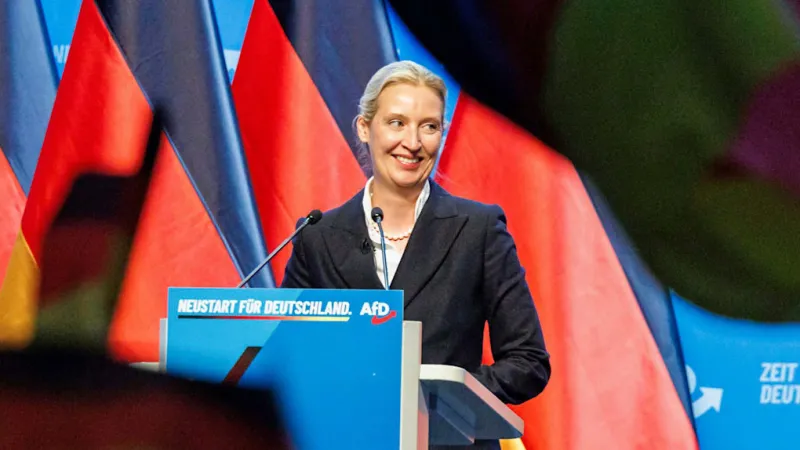
In Erfurt, Germany, Alternative for Germany (AfD) co-leader Alice Weidel emphatically stated her party sees no viable coalition prospects with the current Christian Democratic Union (CDU), an assertion made amidst significant public dissent. This political declaration coincided with a substantial anti-AfD demonstration, where police officials reported an estimated 31,000 counter-protesters converging to voice their opposition during a recent AfD party conference.
Weidel, recently re-elected to her leadership position, specifically targeted Chancellor Friedrich Merz and the CDU, signaling a deep ideological chasm that she believes precludes any potential governing alliance. Her remarks underscore the escalating political polarization within Germany's landscape, particularly concerning the rise of the far-right AfD.
The mass protest in the Thuringian capital served as a powerful counter-narrative to the AfD's gathering, highlighting widespread public concern over the party's platform and its implications for German democracy. Organizers initially projected an attendance of 20,000, a figure ultimately surpassed by the police estimate of 31,000 individuals participating in the peaceful assembly.
The AfD has experienced a surge in popularity in recent years, particularly in eastern German states like Thuringia, where the party often polls strongly. This growth has prompted concerns among mainstream political parties and civil society groups, leading to an increase in organized resistance.
Regarding the potential for future governance, Weidel dismissed the idea of collaborating with Chancellor Merz's party, stating, “With 'this CDU,' there is no coalition option for us.” This firm rejection reaffirms the AfD's position outside the traditional political center, choosing to maintain its distinct, often confrontational, stance.
Chancellor Merz and other leading CDU figures have repeatedly ruled out any form of cooperation or coalition with the AfD at both federal and state levels, citing fundamental differences in values and policy. Weidel's statement appears to reciprocate this sentiment, further solidifying the political barriers between the two parties.
The demonstration in Erfurt was one of several large-scale protests against the AfD that have occurred across Germany in recent months. While the police deemed the overall event peaceful, reports emerged of isolated incidents, including journalists documenting assaults amidst the general chaos, as detailed in reports like Journalists Report Assault Amidst Anti-AfD Protest Chaos in Erfurt.
These demonstrations underscore a robust segment of the German populace actively pushing back against what they perceive as rising right-wing extremism. They represent a significant expression of democratic civic engagement, challenging the AfD's narrative and political legitimacy on a public stage.
Weidel's re-election as co-leader reinforces her influence within the AfD, despite ongoing internal debates and scrutiny, which included former co-leader Tino Chrupalla facing reduced support in his re-election bid, as reported in Chrupalla Secured AfD Leadership, Faces Scrutiny After Reduced Vote. The party's leadership, including figures like Björn Höcke, often polarizes public opinion, with Höcke himself having labeled protesters “soul-wounded” amidst previous mass demonstrations against the AfD.
Historians and political analysts continue to examine the AfD's trajectory, drawing comparisons and delineating rhetorical differences with past far-right movements, as explored in discussions titled Historian Delineates AfD, NSDAP: Rhetorical Gaps and Historical Parallels. These academic perspectives contribute to a broader understanding of the party's place in German political history.
The latest developments in Erfurt serve as a clear indicator of the contentious and fragmented political environment in Germany. With federal and state elections on the horizon, the stances articulated by Weidel and the visible public opposition will undoubtedly shape future campaign strategies and potential alliances.
Ultimately, the events in Erfurt highlight the dynamic interplay between political ambition, public opinion, and democratic resilience in Germany. The persistent refusal of mainstream parties to collaborate with the AfD, coupled with widespread public demonstrations, signals a continued effort to contain the influence of the far-right within the established political order.