 Demian Sahputra
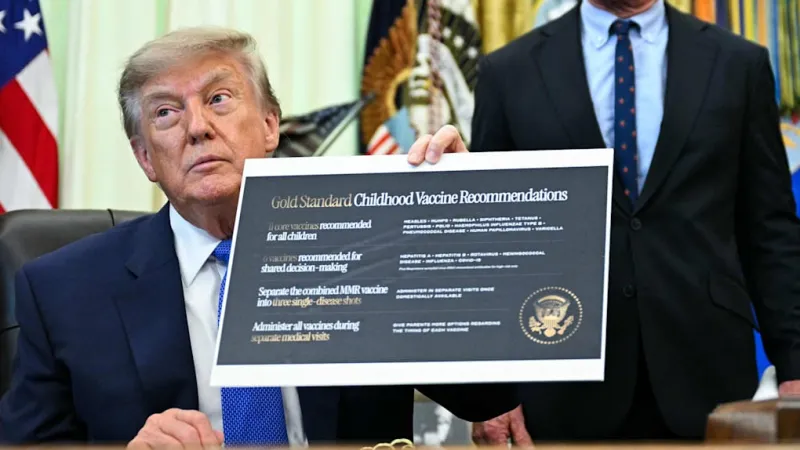
WASHINGTON – President Donald Trump has issued an executive decree significantly altering federal child vaccination recommendations, concurrently reviving unsubstantiated claims linking immunizations to autism spectrum disorders during a press briefing. The President characterized typical vaccine doses as being “in the size of a soda bottle,” a dismissive framing that immediately fueled a contentious national public health debate.
The White House directive, delivered without prior extensive consultation with leading medical organizations, instructs federal health agencies to revise existing guidelines for pediatric vaccinations. This abrupt policy shift diverges sharply from decades of established public health consensus championed by entities such as the Centers for Disease Control and Prevention and the American Academy of Pediatrics.
During his interaction with journalists, President Trump explicitly linked vaccines to autism, a connection widely discredited by comprehensive scientific research. This assertion directly contradicts numerous studies that have found no causal relationship between vaccinations and autism spectrum disorders, reinforcing a long-held misconception that medical experts have worked tirelessly to debunk.
The scientific community and public health advocates swiftly condemned the President’s remarks and the accompanying decree. Prominent medical associations issued statements reaffirming the safety and efficacy of childhood vaccines, emphasizing their critical role in preventing infectious diseases and protecting community health.
Critics argue that President Trump’s actions risk undermining public trust in foundational medical science and could lead to a decline in vaccination rates. Such a decline poses a serious threat of resurgence for preventable diseases, which historically caused widespread morbidity and mortality before the advent of widespread immunization.
President Trump has, on previous occasions, voiced skepticism regarding established vaccination schedules, often citing anecdotal evidence rather than peer-reviewed scientific data. This latest decree and public pronouncements mark a significant escalation of his personal views into official federal policy.
The move resonates with a segment of the population wary of government health mandates and conventional medicine, a demographic that President Trump has historically courted. However, it places his administration at odds with virtually every mainstream medical and scientific organization globally.
Public health officials are now grappling with the practical implications of the decree, which necessitates a rapid overhaul of existing communication strategies and health education materials. The challenge lies in navigating political directives while upholding evidence-based medical practices.
Observers draw parallels to past instances where President Trump’s administration challenged established norms, reflecting a pattern of disruption to long-standing governmental and scientific consensus. This continues a trend seen in various policy areas, including environmental regulations and international relations. For context on broader executive challenges, consider the insights in Ex-CIA Network Warns President Trump Undermining US Democracy.
While the decree mandates a review and revision of recommendations, the specific extent of the recommended reduction in child vaccinations remains unclear, pending detailed guidance from affected agencies. This ambiguity further exacerbates concerns among healthcare providers regarding patient counseling and adherence to new, potentially less protective, schedules.
Pediatricians and family physicians face the difficult task of interpreting and implementing the new federal guidance while continuing to advise parents on what they consider best for their children’s health, based on their professional medical judgment and scientific evidence.
The long-term effects of this executive action could be profound, impacting not only individual child health outcomes but also the broader epidemiological landscape of the United States. Experts warn of potential outbreaks of diseases like measles, mumps, and rubella, which were once largely eradicated due to successful vaccination programs.
The political ramifications are also considerable. The President’s stance is likely to energize his base but could alienate moderate voters and further intensify the cultural divide surrounding scientific authority and public health policy in the lead-up to future electoral cycles. His presidency has frequently faced similar political headwinds, as detailed in President Trump Faces Headwinds: Gaza Plan, Iran, Midterms Converge.
As the nation anticipates the detailed rollout of these revised recommendations, the medical community prepares for a vigorous defense of standard vaccination practices, setting the stage for a protracted and critical debate on the future of pediatric public health in America.