 Demian Sahputra
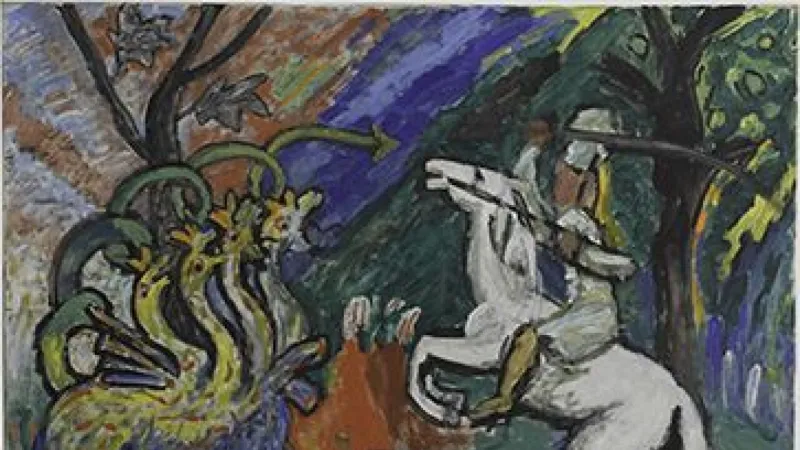
ROME – A significant exhibition at Palazzo Bonaparte is bringing the often-eclipsed work of German Expressionist Gabriele Münter into sharp focus, dedicating a distinct section to her artistic oeuvre alongside a broader presentation of Wassily Kandinsky. This curatorial decision aims to reassert Münter's foundational role in the development of modern art, ensuring her independent contributions receive due recognition.
The exhibition, which opened recently, provides visitors with an unprecedented opportunity to delve into Münter's distinctive style and thematic preoccupations. While her association with Kandinsky and the avant-garde group Der Blaue Reiter (The Blue Rider) is well-documented, this presentation meticulously highlights her individual genius and innovative spirit.
Gabriele Münter, born in Berlin in 1887, was a formidable artist whose career spanned decades. She was a pioneer of German Expressionism, known for her vibrant use of color, bold brushstrokes, and deeply personal interpretations of landscapes, portraits, and still lifes. Her early work, in particular, showcases a remarkable readiness to break from conventional academic styles.
The decision to feature Münter so prominently at Palazzo Bonaparte reflects a growing international trend to re-evaluate and elevate the contributions of female artists historically overshadowed by their male counterparts or familial connections. This Rome exhibition serves as a powerful statement against historical omissions.
Curators emphasized that while Kandinsky's abstract masterpieces also command attention within the broader exhibition, the dedicated segment on Gabriele Münter is designed to stand as a complete narrative of her artistic journey. It traces her evolution from her early, almost Fauvist experiments to her later, more introspective pieces, revealing a consistent artistic voice.
Münter's unique perspective on the world, often capturing the intensity of her emotional experiences, profoundly influenced the direction of European modernism. Her ability to infuse everyday scenes with profound psychological depth sets her apart, demonstrating an unwavering commitment to personal expression.
Palazzo Bonaparte, a historic venue in the heart of Rome, provides an elegant backdrop for these pivotal works. Its storied halls now host a conversation between two artistic giants, yet with a specific emphasis on rectifying past imbalances in art historical discourse.
Visitors to the exhibition will encounter a collection of Münter's canvases, including her evocative landscapes of Murnau, the Bavarian village where she spent significant creative periods. These works, rich in color and simplified forms, exemplify her commitment to expressing inner vision rather than mere external reality.
Through meticulous research and thoughtful curation, the exhibition meticulously reconstructs Münter's artistic trajectory, showcasing her crucial role not just as a participant in groundbreaking movements but as a catalyst for artistic innovation in her own right. Her work is presented not as a derivative but as a parallel, equally potent force.
This dedicated section ensures that Gabriele Münter is celebrated not merely as Kandinsky's companion but as an artist of immense caliber whose contributions continue to resonate. The exhibition ultimately champions her enduring legacy and artistic independence, offering a fresh lens through which to appreciate her profound impact on 20th-century art.