 Dodi Irawan
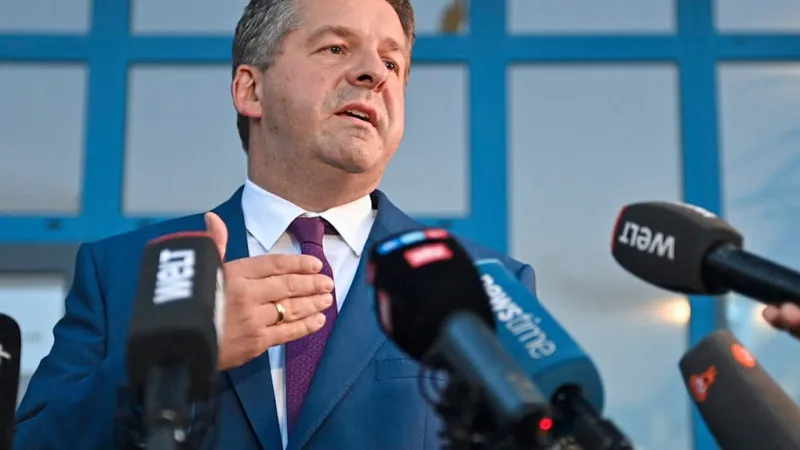
Magdeburg, Saxony-Anhalt — The Christian Democratic Union in Saxony-Anhalt announced upcoming elections for its state executive board, a direct consequence of the party's significant electoral setback. Outgoing state chairman Sven Schulze initiated the leadership transition, while Sepp Müller publicly declared his intent to take the helm. Concurrently, BSW politician Mohamed Ali affirmed her firm stance against electing Ulrich Siegmund as Minister-President, further complicating the region's political landscape.
The decision follows what party insiders describe as a severe electoral debacle, which saw the Saxony-Anhalt CDU lose substantial ground in the recent state election. This performance triggered intense internal reflection and calls for a fundamental reorientation of the party's strategy and leadership in the eastern German state.
Schulze, who has steered the state party through a challenging period, made the announcement regarding the leadership change, signaling a clear path forward for rejuvenation. His move opens the door for new blood and a fresh approach as the CDU navigates a fragmented political environment.
Sepp Müller, a prominent figure within the regional CDU, quickly emerged as a frontrunner for the chairmanship. His public declaration to lead the party suggests a determined effort to stabilize the organization and rebuild its voter base after the disappointing results.
The statement from BSW politician Mohamed Ali holds particular weight given the arithmetic of forming a government. Her categorical refusal to support Ulrich Siegmund as Minister-President creates an additional hurdle for any potential coalition discussions involving Siegmund or parties aligned with him. This echoes prior tensions, as highlighted in the related article Siegmund Challenges CDU Firewall After Saxony-Anhalt Election.
The recent election in Saxony-Anhalt garnered national attention, primarily due to the strong showing of the Alternative for Germany (AfD). This outcome sent shockwaves through the established political parties and intensified debates about coalition possibilities and strategies for countering populist movements. Articles such as AfD's Saxony-Anhalt Triumph Ignites Global Reactions, Berlin Crisis and AfD's Saxony-Anhalt Victory Triggers German Political Upheaval; CDU Shaken documented the immediate fallout.
For the national CDU, the developments in Saxony-Anhalt represent another front in its ongoing struggle to maintain its traditional strength. Local electoral performances often reflect broader sentiment and can influence the party's overall direction and federal strategies.
The path to forming a stable government in Saxony-Anhalt appears increasingly complex. The declared positions of key political actors, coupled with the fractured nature of the recent vote, necessitate intricate negotiations and a willingness to forge unconventional alliances.
Voters in Saxony-Anhalt expressed clear dissatisfaction with the status quo, prompting this urgent call for change within the CDU. The new leadership will face the immediate challenge of regaining public trust and articulating a compelling vision for the state's future.
The internal election process for the state executive board will define the future trajectory of the Saxony-Anhalt CDU. Candidates vying for leadership will undoubtedly present their plans for party reform, electoral recovery, and navigating the challenging political climate.
A new leader for the Saxony-Anhalt CDU could signal potential shifts in regional policy priorities. Observers anticipate discussions on economic development, infrastructure, and social programs, tailored to address the concerns that contributed to the recent electoral outcome.
Saxony-Anhalt has historically been a competitive political battleground, often reflecting broader shifts in German political preferences. The CDU's current predicament underscores the dynamic and often unpredictable nature of state-level politics.
The Bündnis Sahra Wagenknecht (BSW) party, a relatively new entrant, has demonstrated its ability to influence regional outcomes. Mohamed Ali's firm stance against Siegmund exemplifies the party's strategic positioning and its potential as a kingmaker in coalition talks.
Ultimately, the incoming leadership for the Saxony-Anhalt CDU must prioritize stability and a clear message to voters. The party's ability to unite its factions and present a cohesive front will be crucial for its long-term viability and influence in the state.
As the internal leadership race begins, all eyes remain on the Saxony-Anhalt CDU. Its choices in the coming weeks will not only shape its own future but also significantly impact the broader political dynamics within the state and potentially reverberate across Germany's political landscape.