 Demian Sahputra
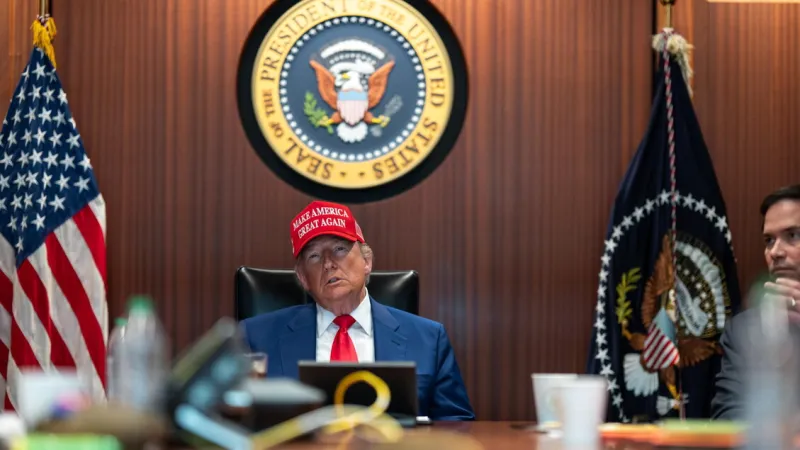
WASHINGTON — President Donald Trump is currently immersed in high-stakes deliberations within the White House Situation Room, poised to render a pivotal decision concerning Iran. This strategic moment unfolds amidst heightened geopolitical tensions, with Tehran unequivocally reaffirming its control over the Strait of Hormuz, a critical maritime chokepoint. The outcome of these discussions is anticipated to significantly impact global stability and energy markets, directly influencing the trajectory of US-Iran relations in 2026.
The President's intensive consultations underscore the gravity of the situation. Advisors and national security officials have presented various scenarios and potential ramifications, ranging from diplomatic overtures to more assertive measures against the Islamic Republic. The atmosphere within the Situation Room reflects the complexity of balancing American interests with regional stability.
Meanwhile, Iranian authorities have conveyed a defiant message to the international community. Sources close to Tehran indicate a renewed emphasis on maintaining what they consider absolute sovereignty over the Strait of Hormuz. This assertion comes as a direct counterpoint to any external pressures or potential military posturing.
The Strait of Hormuz holds immense global significance, acting as the sole sea passage from the Persian Gulf to the open ocean for oil exports from nations including Saudi Arabia, Iran, UAE, Kuwait, and Iraq. Approximately 20% of the worlds petroleum, and a third of all seaborne traded oil, passes through this narrow waterway daily, making any disruption a severe threat to the global economy.
Tensions between the United States and Iran have long simmered, often reaching boiling points over nuclear ambitions, regional proxy conflicts, and maritime security. President Trump's administration has consistently adopted a firm stance against what it perceives as Iranian destabilizing activities across the Middle East.
Past administrations have grappled with similar challenges. For instance, the geopolitical landscape surrounding Iran has seen various diplomatic and sanctions-based approaches. One notable area of discussion concerned the broader implications for regional allies, as detailed in analyses like Trump-Iran Deal: a Political Reckoning for Netanyahu, which explored the impact of US policy shifts on Israeli leadership.
The economic fallout from any escalation in the Gulf region remains a considerable concern. Financial experts have repeatedly warned about the potential for significant spikes in oil prices and broader market instability should military action or a prolonged naval standoff occur. Panetta, for instance, previously highlighted how a Gulf War Risks 6% Eurozone Inflation Amidst Italian Slowdown, underscoring the far-reaching economic consequences.
Beyond immediate military considerations, Iran faces a daunting diplomatic climb to navigate its current position. The nation confronts international isolation on several fronts, struggling to secure economic relief amid persistent sanctions. Analysts have frequently pointed to how Iran Faces Steep Diplomatic Climb Amidst Regional Turmoil as it seeks to project strength while dealing with internal and external pressures.
Regional allies of the United States, particularly Saudi Arabia and the United Arab Emirates, are closely monitoring the Situation Room developments. Their security interests are intrinsically linked to the stability of the Persian Gulf, and any US decision will undoubtedly shape their own strategic responses.
The international community watches with bated breath. Major global powers, including European Union nations, have consistently urged de-escalation and a diplomatic resolution to the standoff. They stress the imperative of maintaining freedom of navigation through critical waterways while also addressing Iran's nuclear program and regional conduct.
The President's impending decision could set a new precedent for engagement or confrontation with Iran. While specific details of the options on his desk remain classified, the message from Tehran is clear: the Strait of Hormuz represents a fundamental aspect of its national security. The coming days will reveal the path forward for one of the worlds most volatile geopolitical flashpoints.