 Dorry Archiles
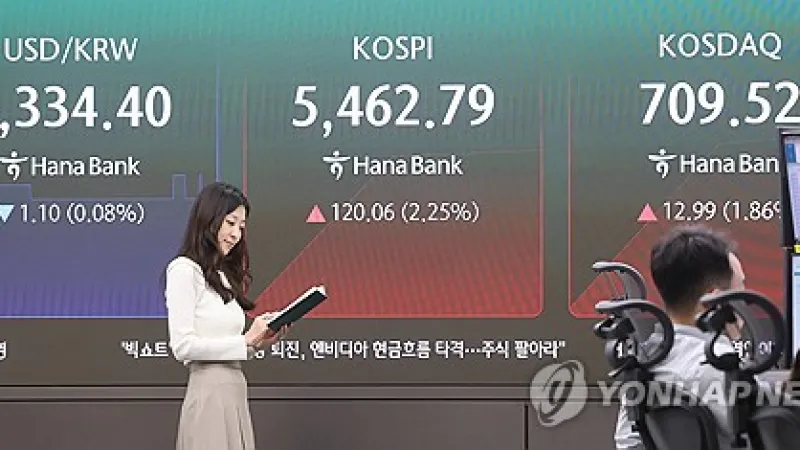
SEOUL – South Korean equities concluded late Friday morning trading sessions with notable gains, defying a backdrop of recent leadership turmoil at graphics processing unit (GPU) titan Nvidia. The market upturn on November 13, 2026, signaled robust investor sentiment and a potential decoupling from the immediate fallout surrounding the U.S. chipmaker, driving the Kospi index higher.
The benchmark Korea Composite Stock Price Index, or Kospi, advanced significantly by midday, recovering ground lost in prior sessions. This upward trajectory was observed across various sectors, although technology and semiconductor-related stocks, surprisingly, led some of the renewed buying interest, indicating a discerning approach by local investors.
The market rally occurred even as global headlines continued to scrutinize the leadership instability plaguing Nvidia. Reports of significant internal shifts and strategic disagreements at the highest levels have cast a shadow over the company, a dominant force in the artificial intelligence and gaming hardware markets. This situation had previously sent ripples of concern through global bourses.
Just days earlier, the ramifications of this internal strife were clearly evident, with Nvidia Scandal Sends Seoul Shares Tumbling Amid Market Jitters. That downturn underscored the profound influence Nvidia, a bellwether for the tech industry, exerts on international financial markets, particularly those with strong semiconductor export ties like South Korea.
Central to the ongoing narrative has been the scrutiny surrounding Tech Visionary Jensen Huang Confronts Scandal-Stained Narrative. As Nvidia's co-founder and CEO, Huangs leadership has been synonymous with the companys meteoric rise. Any perceived instability at the helm inevitably sparks intense speculation and can trigger market volatility.
Analysts attribute Fridays positive performance in Seoul to a combination of factors, including robust domestic economic indicators and a perceived overreaction in previous trading. Investors appear to be reassessing the long-term fundamentals of South Korean companies, many of which boast strong financials independent of Nvidia's immediate operational challenges.
“While Nvidia’s issues are undoubtedly significant globally, the South Korean market has its own inherent strengths and growth drivers,” commented Park Ji-hoon, a senior economist at KB Securities. “We are seeing a strategic rebalancing where local institutional investors are capitalizing on what they view as temporarily undervalued assets.”
Furthermore, broader global economic sentiments might be playing a role. President Donald Trump’s administration continues to emphasize a pro-business stance, which, alongside signs of stabilizing inflation in key economies, could be fostering a cautiously optimistic environment for investors worldwide. These external factors can often temper localized concerns.
The semiconductor sector, a cornerstone of South Korea’s export-driven economy, continues to exhibit long-term growth potential fueled by demand for artificial intelligence, 5G technology, and cloud computing. Despite short-term fluctuations, the underlying demand structure for chips remains strong, providing a fundamental cushion against specific company-level turbulences.
The resolution of Nvidia's leadership issues will undoubtedly be closely watched, as it could dictate future movements in the global tech sector. However, Friday’s trading session in Seoul suggests that the South Korean market possesses a degree of resilience, capable of charting its own course amidst international corporate dramas, at least in the short term.
This newfound resilience might also reflect a maturation of investor strategies, moving beyond immediate knee-jerk reactions to more considered evaluations of systemic health versus individual corporate headwinds. The market is learning to differentiate between temporary setbacks and fundamental shifts.
Beyond semiconductors, South Korea’s economy is diversified, with strong performances in automotive, petrochemicals, and biotechnology. While the tech sector is pivotal, the overall economic framework provides a buffer, preventing a single company’s woes from entirely derailing market confidence.
Investors will now turn their attention to upcoming economic data releases and the evolving narrative surrounding Nvidia. The interplay between global tech developments and domestic economic health will remain a critical determinant for Seoul shares in the coming weeks.