 Robert Andrison
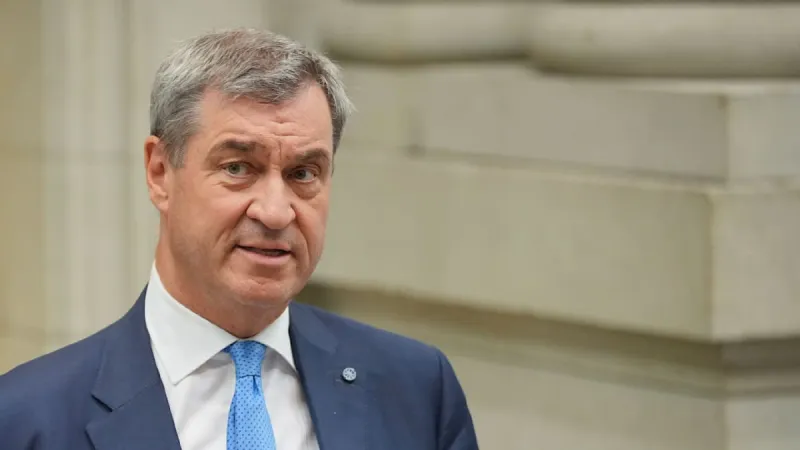
BERLIN – Bavarian Christian Social Union (CSU) leader Markus Söder today voiced strong reservations regarding ongoing discussions about a potential partial ban of the Alternative for Germany's (AfD) Thuringian state chapter. The prominent politician warned that such a move could inadvertently strengthen the far-right party, rather than diminish its influence.
“I do not believe that this is the right path,” Söder stated, emphasizing his skepticism about the efficacy of a ban. He elaborated, “A discussion about a partial ban would currently tend to benefit the AfD.” His comments highlight a deeper debate within German political circles concerning the most effective strategies to counter the rising popularity and radicalization of the AfD.
The discussions center on the Thuringian branch of the AfD, led by Björn Höcke, which has been under intensified scrutiny by Germany’s domestic intelligence agency, the Federal Office for the Protection of the Constitution (BfV). The agency officially classified the Thuringian AfD, along with its Saxony-Anhalt counterpart and the wider youth organization Junge Alternative, as a proven right-wing extremist endeavor.
Legal experts and political observers have been weighing the constitutional implications of banning a political party or a specific state chapter. Germany’s Basic Law allows for the prohibition of parties that seek to undermine or abolish the free democratic basic order. However, the hurdle for such a ban is exceptionally high, requiring significant evidence and a ruling by the Federal Constitutional Court.
Proponents of a ban argue that the Thuringian AfD’s rhetoric and actions consistently cross constitutional boundaries, promoting anti-democratic sentiments and fostering an environment of hate. They believe that decisive legal action is necessary to protect Germany’s democratic institutions from internal threats posed by the extreme right.
However, Söder’s perspective reflects a widely held concern that a ban, even if legally sound, could be politically counterproductive. Opponents argue that it could play into the AfD’s narrative of being a persecuted political entity, allowing them to rally their base and gain sympathy from voters disillusioned with mainstream parties. This perceived victimhood could further energize the party, providing a rallying cry ahead of crucial elections.
The AfD has seen a surge in support across Germany, particularly in the eastern states, including Thuringia. Its platform often capitalizes on public anxieties regarding immigration, economic challenges, and perceived failures of the established political class. This has led to intense pressure on other parties to find effective ways to counter its growing electoral success.
Alternative strategies proposed by political figures include robust engagement in public debate, clearer communication of government policies, and addressing the root causes of voter dissatisfaction that the AfD exploits. Some argue that confronting the AfD ideologically and proving the viability of democratic solutions is a more sustainable approach than attempting to suppress it legally.
The legal precedent for banning a party in Germany is rare. Only two parties have been successfully banned since the end of World War II: the Socialist Reich Party (SRP) in 1952, a successor to the Nazi Party, and the Communist Party of Germany (KPD) in 1956. Both cases involved extensive legal processes and clear findings of anti-constitutional activity.
The debate surrounding a potential AfD partial ban underscores the deep divisions within German politics on how to best handle the rise of extremist movements. While the desire to protect democratic values is universal, the methods to achieve this remain a point of significant contention. Concerns also extend to broader issues of public trust, as evidenced by recent debates on police transparency, such as when Baden-Württemberg police mandated suspect nationality disclosure, a move often debated in the context of perceived far-right narratives.
Political analysts suggest that the German political landscape will likely continue to grapple with the AfD’s presence for the foreseeable future, making the selection of counter-strategies paramount. Whether through legal prohibition or through intensified political and social engagement, the challenge of containing the far-right remains a defining issue for Germany’s democratic future.
Söder’s unequivocal statement contributes significantly to the ongoing discourse, injecting a cautionary note into the calls for a ban. His emphasis on avoiding actions that could inadvertently benefit the AfD will likely shape further discussions among federal and state leaders as they navigate the complex political terrain.