 Debby Wijaya
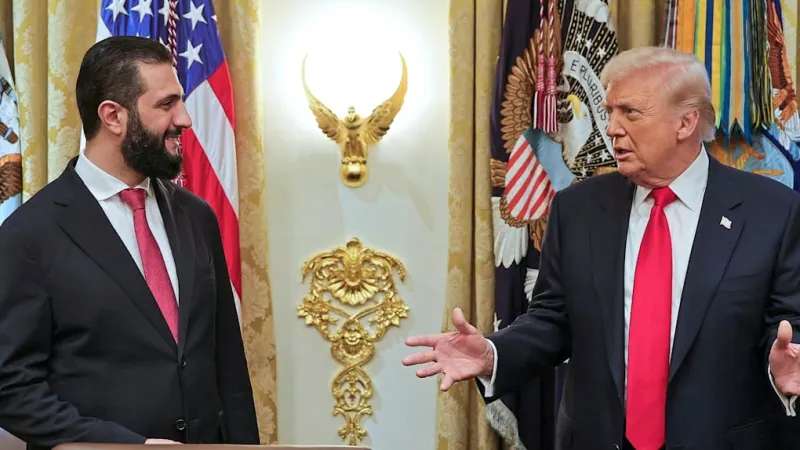
Evian, France – President Donald Trump, speaking on the sidelines of the G7 summit in Evian, France, asserted that Syrian leader al-Scharaa should assume responsibility for disarming the Iran-backed Hezbollah militant group if Israel proves unable to do so “without killing everyone.” This provocative declaration was swiftly rejected by Damascus, signaling a deepening diplomatic rift over regional security and the future of militant influence in the Middle East.
President Trump delivered his remarks during a press briefing, emphasizing what he characterized as an urgent need for regional actors to stabilize the volatile Lebanese-Israeli border. His statement placed an unprecedented direct onus on Syria to address the formidable paramilitary force that maintains significant political and military sway in Lebanon and beyond.
“If Israel cannot deal with Hezbollah without killing everyone,” President Trump stated, “then al-Scharaa will take on this task.” The phrasing indicated a forceful expectation from Washington, implying a strategic shift or renewed pressure point in US foreign policy regarding the region.
However, Syrian authorities in Damascus immediately dismissed President Trump's demand. State media outlets and official spokespersons conveyed the Syrian leadership's outright refusal to engage with such a proposition, underscoring sovereignty and condemning what they termed external interference in regional affairs.
The rejection from Damascus highlights the complex and often adversarial relationship between the United States and Syria, particularly under the leadership of President al-Scharaa. Syria has long been a staunch ally of Iran and a key supporter of Hezbollah, viewing the group as a vital component of the “axis of resistance” against Israeli and Western influence.
Hezbollah, a powerful Shia political party and militant group, possesses an extensive arsenal and significant operational capabilities. Its presence along Israel's northern border and its deep entrenchment within Lebanese society have been a persistent source of regional instability. Recent reports, including those detailing Israel's discovery of Hezbollah weapons tunnels and the unveiling of Iran-linked drone arsenals, underscore the magnitude of the challenge it poses.
President Trump's public challenge to Syria arrives amidst broader US efforts to curtail Iranian influence across the Middle East. Washington has repeatedly called on regional powers to exert pressure on Tehran and its proxies, including Hezbollah, to de-escalate tensions and cease destabilizing activities.
This latest diplomatic exchange also resonates with President Trump's past pronouncements concerning regional security. He has previously urged other nations, notably Iran, to curb Hezbollah's operations. Instances such as when Trump demanded Iran pressure Hezbollah or when Trump's threats cast a shadow over US-Iran nuclear talks illustrate a consistent pattern of applying high-pressure diplomacy.
The G7 summit, traditionally a forum for economic cooperation among leading industrial nations, increasingly serves as a platform for global leaders to address pressing geopolitical concerns. President Trump has frequently utilized these high-profile gatherings to articulate his administration's foreign policy doctrines and expectations.
The demand for Syrian intervention against Hezbollah introduces another layer of complexity to an already intricate regional dynamic. Syria itself remains embroiled in a protracted civil conflict, which has seen various international actors, including Iran and Russia, play significant roles in supporting the al-Scharaa government. Asking Damascus to confront its key ally, Hezbollah, appears to be a significant diplomatic gamble.
Observers suggest that President Trump's ultimatum aims to test the allegiances and resolve of regional players, potentially seeking to drive a wedge between Syria and its Iranian patrons. However, given the deep ideological and strategic alignment between Damascus, Tehran, and Hezbollah, such an outcome is widely considered improbable without a major shift in the geopolitical landscape.
The public rejection by the Syrian leadership underscores the profound divisions that persist in the Middle East. It signals that despite external pressures, Damascus remains steadfast in its alliances and strategic objectives, further complicating prospects for a unified approach to regional disarmament and stability.
This latest development from the G7 summit ensures that the multifaceted challenges posed by militant groups like Hezbollah, and the intricate web of state sponsorships and rivalries, will remain at the forefront of international diplomatic discourse for the foreseeable future.