 Dorry Archiles
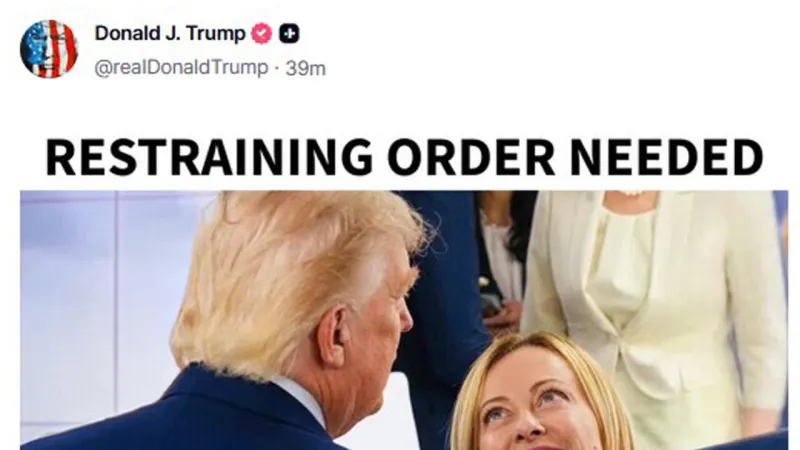
BRUSSELS – President Donald Trump ignited a diplomatic firestorm on the eve of a pivotal NATO summit, publicly attacking Italian Prime Minister Giorgia Meloni on his social media platform, Truth Social. The President posted a meme suggesting a "restrictive order" was needed for the Italian premier, drawing sharp rebukes from Italian political figures and casting a shadow over the alliance's upcoming deliberations in 2026.
The contentious post, widely circulated shortly before leaders were scheduled to convene, featured an image of Prime Minister Meloni accompanied by text calling for a "restrictive order." While the specific context of the demand remained ambiguous, the sentiment was clear: a direct and public challenge to a key European ally by the US President. This unprecedented digital broadside has rattled diplomatic circles, prompting immediate reactions from Rome.
Italian Foreign Minister Antonio Tajani swiftly condemned President Trump's remarks, stating they were "words that speak for themselves." Tajani underscored the importance of maintaining robust diplomatic relations between Italy and the United States, irrespective of individual political posturing. His measured response sought to balance a defense of Italian sovereignty with the imperative of alliance cohesion.
The timing of President Trump's social media salvo is particularly significant, occurring just as NATO members prepare to address pressing global security challenges. The upcoming summit is expected to focus on issues ranging from ongoing conflicts to regional stability, where unified leadership from member states is paramount. Such public discord between two prominent leaders threatens to undermine the collective strength and diplomatic efforts of the transatlantic alliance.
Matteo Salvini, Italy's Deputy Prime Minister and leader of the League party, adopted a more cautious tone, indicating his reluctance to engage with the President's comments. "I do not comment on these things anymore," Salvini remarked, signaling a potential strategy to avoid further escalating the rhetorical exchange. His stance suggests an effort to de-escalate rather than directly confront the provocative statement.
Guido Crosetto, Italy's Minister of Defense, emphasized the enduring nature of US-Italian relations, regardless of transient political figures. "People pass, but relations with the United States must remain," Crosetto asserted, highlighting the institutional strength of the alliance over personal disputes. His statement aimed to reassure observers of the fundamental stability of the bilateral relationship despite temporary friction.
In stark contrast, Carlo Calenda, a prominent Italian senator and leader of the Azione party, offered a more scathing assessment of President Trump's behavior. Calenda publicly labeled the US President a "four-bit bully," expressing strong disapproval of what he perceived as undignified and counterproductive diplomatic conduct. This robust criticism reflects a segment of Italian political opinion deeply concerned by the President's approach.
President Trump has a history of unconventional diplomatic engagements, often utilizing social media to express strong opinions on international leaders and policies. His Truth Social platform has become a primary conduit for these pronouncements, frequently bypassing traditional diplomatic channels and directly influencing public discourse. This pattern often generates both support among his base and considerable consternation among international allies.
The incident raises critical questions about the stability and future direction of NATO, especially as it grapples with internal cohesion and external threats. A publicly fractured relationship between the leaders of two foundational member states could embolden adversaries and complicate coordinated responses to global crises. The alliance relies on mutual respect and cooperation to project strength and resolve.
Analysts suggest that President Trump's remarks may also be interpreted through the lens of domestic politics, potentially aimed at galvanizing his base or signaling a particular stance on immigration or economic policies that differ from Meloni's positions. However, the international ramifications of such statements are undeniable, potentially souring critical bilateral meetings and wider multilateral discussions at the summit.
Prime Minister Meloni has consistently maintained a pro-NATO, pro-Ukraine stance since taking office, aligning Italy with mainstream Western foreign policy objectives. While she shares certain conservative ideological commonalities with President Trump, her administration has largely upheld Italy's commitments to international alliances and multilateralism, making the President's attack particularly striking.
The immediate challenge for diplomats will be to navigate these public tensions while maintaining a united front at the NATO summit. Efforts will likely be made behind the scenes to mend fences and ensure that the alliance's strategic agenda is not derailed by individual political spats. The efficacy of these efforts will be closely watched by international observers. The recent development echoes previous instances of strain in transatlantic relations, as highlighted in articles like Trump's Meloni Attack Ignites Pre-NATO Summit Tensions.