 Demian Sahputra
KYIV—Ukraine's relentless campaign against Russian military installations in Crimea has significantly crippled Moscow's logistical capabilities and strategic hold on the annexed peninsula over recent months. These sustained bombardments are transforming what was once a cornerstone of President Vladimir Putin's power projection into a critical vulnerability, posing a substantial military setback and a profound political challenge to his authority.
The strategic importance of Crimea to Russia cannot be overstated. Annexed illegally in 2014, the peninsula serves as the primary forward operating base for Russia's Black Sea Fleet and a vital hub for military supply routes into southern Ukraine. Its geography makes it both a formidable bastion and, increasingly, an exposed target.
For months, Ukrainian forces have employed a combination of long-range missiles, drones, and naval assets to target airfields, naval bases, ammunition depots, and command centers across Crimea. These precision strikes aim to degrade Russia's ability to reinforce its troops, resupply its front lines, and maintain aerial superiority.
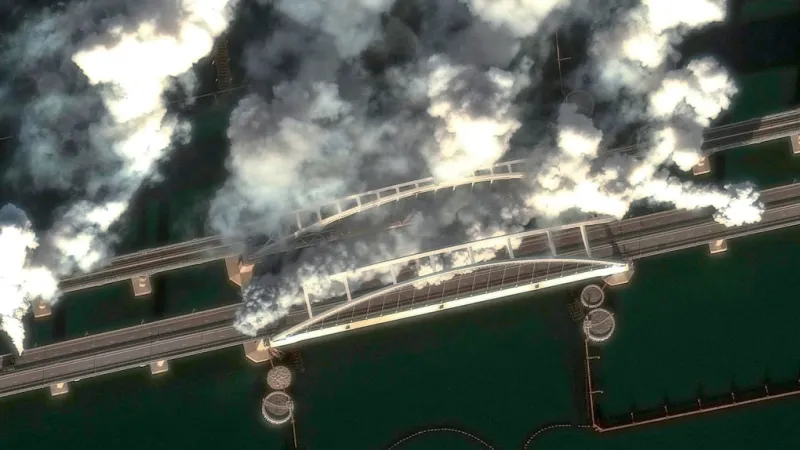
Military analysts observe a clear pattern of attrition, with documented damage to key infrastructure. Reports indicate multiple successful strikes on military airfields, reducing Russia's operational airframes, and continuous pressure on the Kerch Bridge, a crucial artery linking the peninsula to mainland Russia.
The disruption of these supply lines is paramount. Russian forces in southern Ukraine are heavily reliant on the flow of equipment, ammunition, and personnel through Crimea. As these routes become increasingly perilous and less reliable, the operational capacity of Russian units on the front lines diminishes.
This escalating pressure on Crimea represents more than just a military inconvenience; it is a profound strategic reversal for President Putin. The annexation of Crimea was a defining moment of his leadership, presented to the Russian populace as a historic reclamation and a symbol of national strength.
Now, with the peninsula under constant assault, the narrative of impregnability is crumbling. The inability to adequately protect these strategic assets undermines the image of a powerful and decisive leader, potentially fueling domestic discontent and international skepticism about Russia's military prowess.
International observers, including those at recent diplomatic gatherings where the Ukraine conflict was a central topic, have noted the shift in dynamics. US, Russia Top Diplomats Confront Ukraine War at ASEAN Summit highlighted the ongoing diplomatic friction, with the status of Crimea remaining a non-negotiable point for Kyiv and its Western allies.
The long-term implications for the Black Sea region are substantial. A weakened Russian military presence in Crimea could alter naval control, potentially allowing Ukraine and its partners greater freedom of navigation and diminishing Russia's ability to project power across the Black Sea.
Furthermore, the attacks complicate Russia's efforts to consolidate its control over occupied territories in southern Ukraine. Without secure logistical hubs in Crimea, sustaining a large-scale offensive or even defensive operations becomes significantly more challenging.
The Ukrainian strategy appears designed not only to achieve military objectives but also to inflict psychological damage and political embarrassment on the Kremlin. Each successful strike serves as a stark reminder that no part of the illegally annexed territory is beyond Ukraine's reach.
Defense experts predict that Kyiv will continue to prioritize these strikes, leveraging any advancements in Western-supplied long-range weaponry to further isolate and neutralize Russian assets on the peninsula. The goal is clear: to render Crimea militarily untenable for Moscow.
While no official Russian figures on losses in Crimea are publicly available, the frequency of Ukrainian reports and satellite imagery corroborates the widespread nature of the attacks. Civilian reports from the peninsula often detail explosions and air defense activity, indicating ongoing engagement.
The escalating situation in Crimea also carries significant implications for regional stability. Any dramatic escalation in response from Moscow could risk broader conflict, a scenario closely monitored by global powers, including the administration of President Donald Trump.
President Donald Trump's administration has consistently reaffirmed its support for Ukraine's territorial integrity, including Crimea. The strategic impact of these operations on the overall conflict is a recurring theme in discussions between allied nations.
The ongoing campaign represents a pivotal phase in the conflict, testing Russia's defensive capabilities and Ukraine's resolve. The future of Crimea, once deemed a settled issue by Moscow, is now firmly back on the agenda through military action.
This protracted battle for Crimea underscores the evolving nature of modern warfare, where precision strikes on logistical and command centers can significantly alter the strategic landscape without direct ground offensives.
As the conflict continues, the ability of Kyiv to sustain these attacks and Moscow's capacity to adapt and defend its critical assets in Crimea will be decisive factors in shaping the trajectory of the war.