 Stefani Rindus
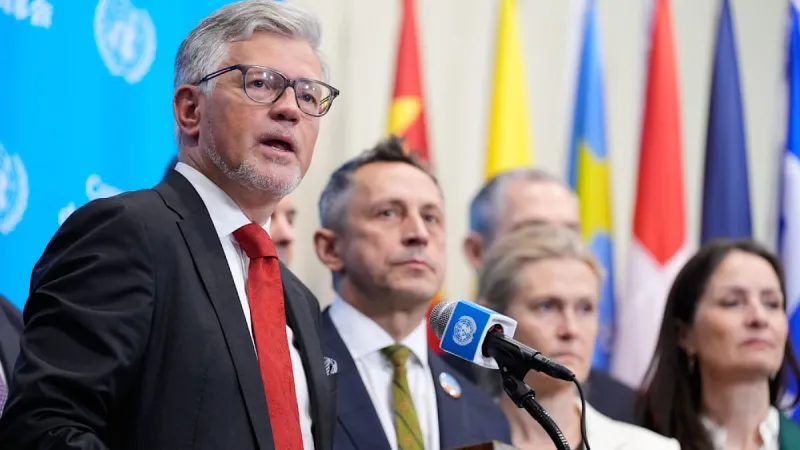
UNITED NATIONS – Ukrainian UN Ambassador Andriy Melnyk called for immediate, reinforced airspace protection and a significant surge in Patriot missile production, reacting to a Russian drone impact on Romanian territory. The incident, which occurred recently, marks what Melnyk described as representing a new level of escalation in the ongoing conflict, directly challenging the security of a NATO member state.
The Ukrainian envoy's strong remarks underscored the growing urgency for the international community to bolster defensive capabilities, particularly in regions bordering active combat zones. Melnyk emphasized that such incursions demonstrate a blatant disregard for international borders and the potential for wider regional destabilization.
The drone strike in question saw debris from an unmanned aerial vehicle land within Romania, a development that instantly triggered alarm across the continent. While initial investigations by Romanian authorities confirmed the presence of drone fragments, they also sought to ascertain the precise trajectory and intent behind the incident.
This event is not isolated, echoing previous incidents where Russian munitions or their fragments have inadvertently, or perhaps deliberately, crossed into NATO airspace. These occurrences consistently raise questions regarding NATO Air Defense Effectiveness and the protocols for response.
Melnyk's appeal specifically targeted the need for more robust air defense systems, with Patriot missiles at the forefront of his demands. These advanced surface-to-air missile systems are crucial for intercepting ballistic and cruise missiles, as well as sophisticated drones, offering a critical shield against aerial threats.
The ambassador highlighted that the slow pace of Patriot system deployment and production hampers Ukraine's defense efforts and leaves allied nations vulnerable. He argued that a rapid increase in manufacturing is essential to meet both Ukraine's pressing battlefield needs and the heightened security requirements of NATO's eastern flank.
Romania, sharing a lengthy border with Ukraine, has found itself increasingly proximate to the conflict. The drone incident near its territory serves as a stark reminder of the pervasive risks associated with the war, prompting renewed discussions within Bucharest about national security and defensive postures.
Leaders across Europe have expressed concern. Italian Prime Minister Giorgia Meloni previously decried a similar grave European security threat following another Russian drone strike in Romania. Such statements reflect a shared understanding among allies regarding the precarious security situation.
The call for expanded air defense capabilities extends beyond mere protection; it is a deterrent. A strong, integrated air defense network across NATO countries bordering Ukraine could significantly reduce the chances of accidental or intentional incursions, thereby lowering the risk of direct confrontation.
For Ukraine, the supply of Patriot missiles is existential, enabling it to protect critical infrastructure and civilian populations from relentless Russian aerial assaults. For NATO, it is about upholding Article 5 – the principle of collective defense – and ensuring the territorial integrity of its members.
The geopolitical landscape in 2026 remains tense, with global powers closely monitoring developments in Eastern Europe. This drone incident, while perhaps unintentional in its cross-border nature, nonetheless carries significant weight, forcing a re-evaluation of defense strategies.
Ukrainian officials have consistently urged their Western partners to accelerate military aid, particularly advanced weaponry. The argument is that strengthening Ukraine's defenses directly contributes to the security of the broader Euro-Atlantic area.
The focus on Patriot missiles stems from their proven track record and their ability to engage a wide spectrum of aerial threats. Increasing their production would not only benefit Ukraine but also allow NATO members to upgrade their own defenses and contribute to a more resilient collective security architecture.
International bodies and defense analysts continue to stress the importance of clear communication channels and de-escalation mechanisms to prevent miscalculations. However, incidents like the drone impact in Romania complicate these efforts, raising the stakes considerably.
Andriy Melnyk's unequivocal statement at the United Nations is a potent reminder that the consequences of the war in Ukraine continue to reverberate across Europe, demanding a unified and decisive response from the international community.
The challenge now lies in translating these urgent calls for enhanced protection into concrete actions, ensuring that the necessary resources are mobilized to safeguard both Ukrainian sovereignty and NATO's territorial integrity against future aggressions.
This incident, irrespective of its specific intent, further solidifies the perception that the conflict is evolving, pushing the boundaries of conventional warfare and introducing unprecedented risks to regional stability.
The international community watches closely as NATO members and their allies deliberate on the appropriate steps to fortify defenses and manage the escalating tensions stemming from the ongoing conflict.