 Chandra Wijayanto
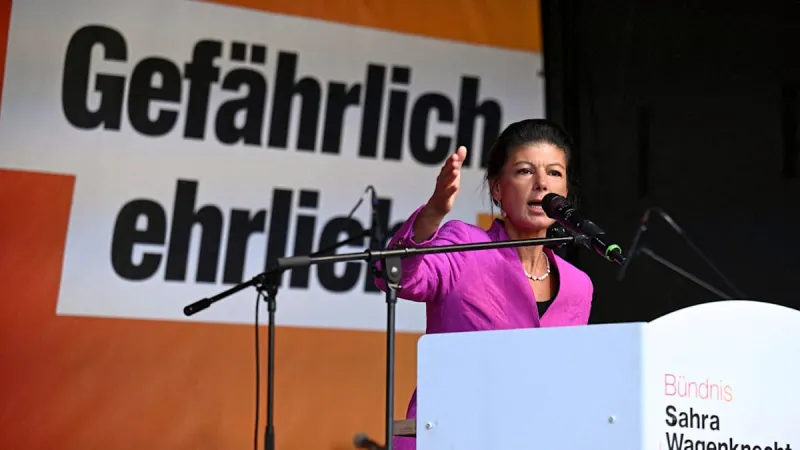
SCHWERIN – Sahra Wagenknecht, a prominent figure in German politics, has issued a direct appeal for tactical votes to her newly formed Bündnis Sahra Wagenknecht (BSW) party, ahead of the critical Mecklenburg-Vorpommern state parliamentary election slated for September 20, 2026. This strategic call carries significant weight, as current projections indicate the Christian Democratic Union (CDU) faces a genuine threat of being excluded from the state legislature if the five-percent electoral threshold is not met.
Wagenknechts intervention aims to consolidate support for the BSW in a pivotal regional contest, transforming the upcoming vote into a stark referendum on established parties and a test for her burgeoning movement. Her message resonates with voters disaffected by mainstream politics, challenging the traditional party landscape in one of Germanys northeastern states.
The BSW, launched earlier this year, seeks to carve out a distinct political identity by combining socially conservative views with left-leaning economic policies. Its platform has garnered attention across Germany, attracting a diverse voter base frustrated with issues such as immigration, economic stagnation, and the perceived detachment of conventional political elites.
For the CDU, the prospect of parliamentary exclusion in Mecklenburg-Vorpommern represents a substantial blow and a stark warning. The party, a traditional powerhouse in German politics, has seen its support erode in various regions amidst a shifting electorate and the rise of alternative political forces.
Historical data reveals a fluctuating performance for the CDU in the state, but outright expulsion from the Landtag would mark an unprecedented low. Such a development would undoubtedly trigger intense introspection within the party and could have ripple effects on national political discourse.
The concept of tactical voting, where citizens cast their ballot for a party other than their primary choice to achieve a specific outcome, is not new in German elections. However, Wagenknechts explicit endorsement of such a strategy underscores the high stakes involved for both the BSW and the established political order.
Analysts suggest that if a significant portion of voters indeed follows Wagenknechts advice, the BSW could gain unexpected strength, fundamentally altering the coalition possibilities and legislative dynamics within Mecklenburg-Vorpommern. The move is a calculated gamble to maximize the new party's impact.
Other established parties in the state, including the Social Democrats (SPD) and the Greens, are closely monitoring the situation. A weakened CDU could lead to a realignment of power, potentially complicating future coalition negotiations and governance within the region.
Political commentators emphasize that the current political climate in Germany is ripe for disruption. Mainstream parties, including centrist factions, have faced increasing challenges in retaining voter confidence, as noted in discussions surrounding issues like the German Centrists Paralysed by Fear. This vulnerability creates fertile ground for new movements like the BSW.
Furthermore, the broader debate surrounding the future of German democracy, including discussions about banning certain parties, highlights the underlying tensions. Experts have warned that such measures could paradoxically Empowering Germany's Far-Right, showcasing a volatile political landscape where voter loyalties are increasingly fluid.
The September 20 election in Mecklenburg-Vorpommern will therefore be more than just a regional contest; it will serve as a crucial barometer for the political mood across Germany. The outcome will signal whether Wagenknechts BSW can translate its national profile into tangible electoral success and whether the traditional dominance of parties like the CDU is indeed on increasingly shaky ground.