 Chris Robert
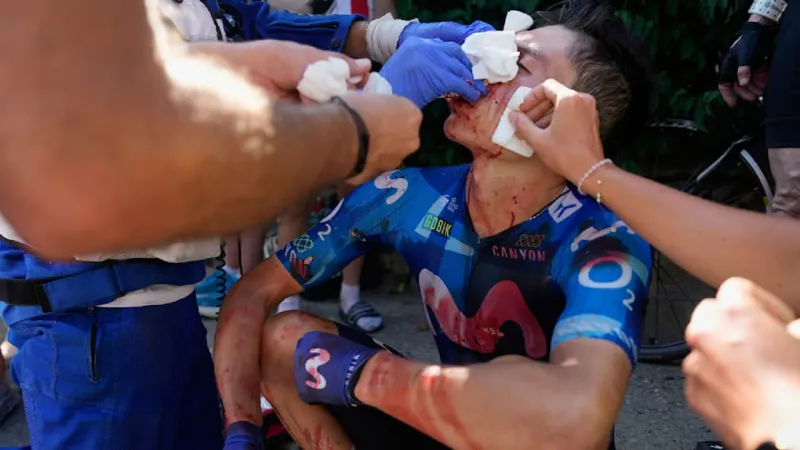
Alpe d'Huez – A shocking incident at the legendary Alpe d'Huez climb during the Tour de France saw professional cyclist Einer Rubio of Movistar Team crash violently into a suddenly halted support vehicle, sustaining injuries that required immediate medical attention. The abrupt stop by the race vehicle was reportedly a direct consequence of a spectator's proximity, highlighting perennial safety concerns along the prestigious route.
The collision occurred during a critical juncture of the race, drawing gasps from onlookers and causing a significant disruption to the peloton's ascent. Rubio, identified as the rider involved, reportedly impacted the vehicle with full force, leaving him visibly bloodied on the tarmac as medical teams swiftly converged on the scene.
Witness accounts and initial reports indicate that the accompanying vehicle was forced to deploy its brakes unexpectedly. This sudden maneuver left Rubio, who was closely following, with insufficient time to react, leading to the high-impact collision. The precise nature and extent of Rubio's injuries have not yet been fully disclosed, though he was observed to be in distress.
The incident immediately reignited discussions about spectator control and safety protocols at major cycling events, particularly on iconic and challenging climbs where crowds often narrow the available road space for riders and support staff. Event organizers frequently grapple with the balance between fan engagement and athlete security.
This is not an isolated occurrence within professional cycling, a sport renowned for its accessibility to spectators who line the routes for hundreds of kilometers. Previous editions of the Tour de France and other Grand Tours have seen similar disruptions, ranging from minor inconveniences to serious crashes caused by overzealous or inattentive fans.
Such incidents pose a significant threat not only to the athletes but also to the integrity of the race itself. The presence of fans on the course, while an integral part of cycling's allure, necessitates rigorous planning and enforcement to prevent hazards that can alter race outcomes or, more critically, endanger lives.
The Tour de France race directorate and team management are expected to issue statements regarding the crash and any potential investigations into the circumstances surrounding the fan's involvement. The immediate concern remains Rubio's well-being and his ability to continue in the race.
Safety measures, including barriers, designated fan zones, and increased security personnel, are consistently evaluated. However, the sheer scale of the Tour de France makes absolute containment challenging. The incident underscores the urgent need for enhanced spectator awareness and self-policing among cycling enthusiasts.
In related discussions regarding the sport's future, a recent report highlighted how a cycling boss demands radical reform, proposing Tour de France entry fees. While controversial, such proposals often stem from a desire to address systemic issues, including those related to safety and the financial sustainability of events, though direct links to fan-induced crashes are not always the primary driver.
Rubio's team, Movistar, is expected to provide updates on his condition as soon as comprehensive medical assessments are complete. The cycling world watches closely, hoping for a swift recovery for the talented Colombian rider and for renewed commitments to athlete safety from race organizers.
The sight of a bloodied professional cyclist on the roadside, a direct consequence of an external factor, serves as a stark reminder of the fragile nature of these high-stakes competitions and the constant vigilance required to protect its participants.
As the Tour de France continues, the peloton will undoubtedly carry the memory of this incident, perhaps prompting a more cautious approach from both riders and support staff as they navigate the remaining stages, particularly those with dense crowds.
The challenge for event organizers remains to preserve the unique atmosphere of the Tour de France, where fans can get incredibly close to their heroes, while simultaneously eliminating the very real dangers that proximity can unfortunately create.
This incident will likely trigger a review of protocols, especially concerning support vehicles operating within the race bubble and their interaction with the unpredictable nature of roadside spectators. The paramount goal is to ensure the safety of all participants and maintain the competitive integrity of the sport.
The Tour de France, often celebrated as a pinnacle of athletic endurance and human spirit, faces the perennial task of adapting to modern challenges, ensuring that spectacular racing is not overshadowed by preventable tragedies.