 Edward DP Situmorang
Berlin—Astronaut Ulrich Walter, a distinguished physicist and former space shuttle mission specialist, recently offered a compelling analysis of the distinct chromatic phenomena witnessed during a recent solar eclipse. Appearing in a broadcast studio, Walter illuminated the unique beauty inherent in the celestial event's striking separation of colors, an observation he described as particularly captivating.
Walter, known for his ability to translate complex scientific concepts for the public, highlighted how the specific conditions of this eclipse allowed for an unusual clarity in the observable light spectrum. This clarity revealed nuances often obscured in less optimal viewing circumstances, drawing significant attention from both professional astronomers and amateur enthusiasts.
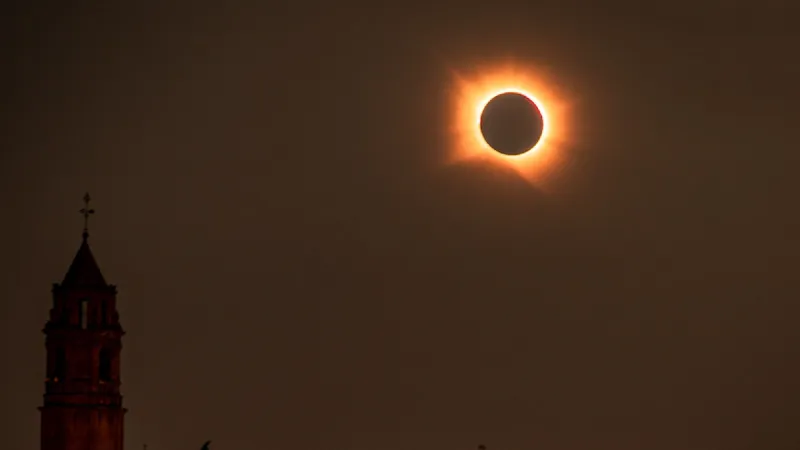
“There is a separation of colors and that is precisely the beauty,” Walter reportedly enthused during his studio appearance, conveying a profound sense of wonder. His commentary underscored the emotional and intellectual impact such rare astronomical events have on observers worldwide, moving beyond mere scientific data collection to an appreciation of cosmic artistry.
During a solar eclipse, when the moon perfectly aligns between the sun and Earth, the sun's corona becomes visible. It is within this fleeting moment that the diffraction and refraction of light through Earths atmosphere and the suns chromosphere can create spectral anomalies, leading to the distinct color banding Walter described.
The public fascination with solar eclipses continues to grow, fueled by enhanced global media coverage and scientific outreach. Recent events have drawn millions of viewers, both in person and via live streams, eager to witness these astronomical marvels. Global audiences were thrilled by the Spectacular Solar Eclipse Livestream that captured the event's grandeur.
While every solar eclipse presents its own unique set of circumstances, the atmospheric conditions present during this particular event reportedly contributed to the pronounced visual effect Walter detailed. The clarity of the air and the precise alignment facilitated an unparalleled view of these chromatic dynamics.
Throughout history, solar eclipses have inspired awe and spurred scientific inquiry. Modern observation techniques, coupled with expert commentary like Walters, deepen our understanding not just of the sun and moon, but also of Earth's atmosphere and light itself. Anticipation often builds for years ahead of these events, particularly in regions where they are a rare occurrence, such as when Europe Anticipates First Total Solar Eclipse in 27 Years.
Experts like Walter play a critical role in educating the public and fostering a deeper appreciation for space science. Their direct experiences and scientific acumen provide invaluable insights, transforming what might appear as a simple darkening of the sky into a rich tapestry of physical processes and aesthetic wonder.
Observers across Europe have recently experienced their own celestial spectacles. Although sometimes viewed through cloud veils, these events still manage to captivate and demonstrate the enduring power of astronomical phenomena. Many followed the event as Europe Witnessed Celestial Spectacle: Total Solar Eclipse Captivates Millions.
The observations and explanations from scientists such as Walter provide crucial data points for heliophysicists studying the sun's corona and its interactions with Earth's magnetosphere. Understanding these phenomena contributes to better space weather forecasting and fundamental research into stellar physics.
The spectacle of a solar eclipse, particularly one revealing such distinctive color separation, serves as a powerful reminder of the universe's inherent beauty and the intricate mechanics that govern our solar system. Walters account vividly captured this confluence of science and aesthetics.
These profound descriptions from seasoned astronauts and scientists help bridge the gap between complex astronomical events and public understanding, ensuring that each solar eclipse leaves a lasting impression and inspires future generations of scientists and sky-gazers.