 Dodi Irawan
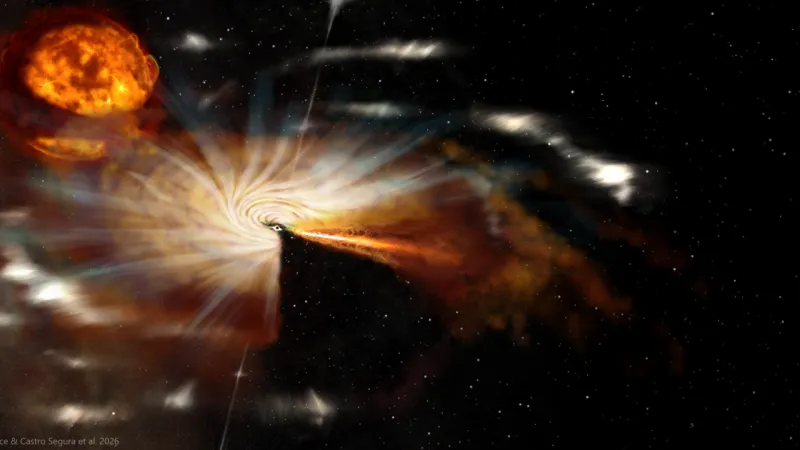
SPACE – Recent groundbreaking observations by a collaborative team of international astronomers have revealed a phenomenon dubbed "cosmic indigestion" occurring within a supermassive black hole, fundamentally altering established theories that describe these colossal objects as immutable, bottomless gravitational wells.
The unprecedented event, detailed in a series of published findings, captures a black hole not merely consuming matter, but also exhibiting periods where accretion slows or even expels material, indicating a more complex interaction with its environment than previously modeled.
For decades, the prevailing scientific consensus characterized black holes as ultimate cosmic devourers, objects from which nothing, not even light, could escape once crossing their event horizon. This new evidence introduces a nuanced perspective on their feeding habits.
Researchers utilized advanced X-ray and radio telescopes, including the next-generation Event Horizon Telescope array, to meticulously track the activity emanating from the heart of a distant galaxy. The data provided a granular view of the black hole's dynamic processes.
The term "indigestion" colloquially describes the observed erratic feeding behavior, where large quantities of gas and dust are drawn in, only for some of that material to be temporarily halted or even violently ejected back into space through powerful jets, preventing a continuous, smooth infall.
This behavior suggests that black holes might possess a self-regulating mechanism, preventing them from growing indefinitely at a constant rate. Such a mechanism could have profound implications for galaxy evolution and the distribution of matter in the universe.
"What we are witnessing is a paradigm shift in black hole astrophysics," stated Dr. Elena Rossi, lead researcher on the project, in a recent scientific briefing. "These are not just cosmic drains; they are active, dynamic entities that interact complexly with their surroundings."
The implications extend beyond theoretical astrophysics. Understanding these feedback loops is crucial for comprehending how supermassive black holes influence the birth and death of stars, and how they shape the structure of entire galaxies.
This "cosmic indigestion" provides critical data points that will enable scientists to refine existing black hole models and potentially develop entirely new theoretical frameworks that account for these intricate energetic interactions.
Future observational campaigns, leveraging enhanced telescope capabilities and new data analysis techniques, aim to identify similar phenomena in other black holes across the cosmos, confirming whether this event is an anomaly or a widespread characteristic.
The findings challenge the elegant simplicity of the "bottomless pit" analogy, painting a more turbulent and intricate picture of the universe's most mysterious objects. It underscores the continuous evolution of our cosmic understanding.
The ongoing quest to decode the universe's most enigmatic phenomena continues to yield surprises, pushing the boundaries of human knowledge and reinforcing the notion that much remains to be discovered beyond Earth's atmosphere.