 Robert Andrison
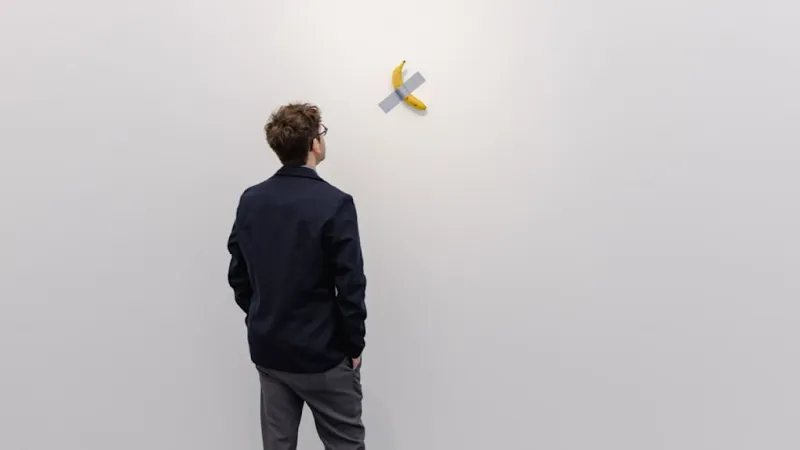
Paris – Maurizio Cattelan's provocative artwork, "Comedian," a simple banana affixed to a wall with duct tape, recently sparked international headlines over a supposed theft from the Centre Pompidou, only for the incident to be revealed as another calculated performance designed to draw widespread attention to the piece and its inherent critique of the art market. The incident, which unfolded over the past week, served as a stark reminder of the work's consistent ability to manipulate public perception and media discourse, generating reliable controversy since its debut.
Reports initially surfaced of the artwork's disappearance, leading to a flurry of speculation across social media and art news outlets. However, museum officials and representatives for Cattelan quickly clarified that the perceived theft was not a genuine criminal act but rather part of the work's conceptual framework, blurring the lines between art, publicity, and public participation. This characteristic maneuver has become a hallmark of Cattelan's artistic practice.
First exhibited in 2019 at Art Basel Miami Beach, "Comedian" quickly became an international sensation. Its initial iterations involved a fresh banana, periodically replaced, sold for significant sums ranging from $120,000 to $150,000, creating an immediate furor over what constitutes value in contemporary art. The piece challenged conventional notions of permanence, authorship, and market worth.
The recent event at the Centre Pompidou echoes past spectacles involving "Comedian." In Miami, a performance artist famously removed and ate the banana, claiming it was "art performance" and that the act was "very delicious." Another instance involved a man spray-painting the wall where the banana was displayed. These acts, whether spontaneous or orchestrated, invariably amplify the artwork's visibility and deepen its controversial legacy.
Cattelan, an Italian artist renowned for his satirical and often morbid works, consistently uses humor and subversion to critique societal norms and the art establishment itself. His work frequently forces audiences to confront uncomfortable truths about consumerism, wealth, and the often-absurd valuation processes within the art world. "Comedian" stands as perhaps his most distilled statement on these themes.
The public's reaction to "Comedian" is as much a part of the artwork as the banana and tape themselves. Each 'scandal' feeds into a larger narrative, drawing in new audiences who might otherwise ignore contemporary art. The media plays a critical role in this cycle, often sensationalizing incidents, which only further validates Cattelan's ongoing commentary on the spectacle-driven nature of modern culture.
Sources close to the Centre Pompidou indicated the museum embraces the work's inherent capacity for generating discourse. While ensuring the integrity of its exhibitions remains paramount, the institution recognizes the unique position "Comedian" holds in prompting vital discussions among visitors and critics alike about the ephemeral and subjective nature of artistic expression. The piece functions as a conversation starter.
"Comedian" resonates with a lineage of conceptual art that prioritizes ideas over traditional aesthetics or craftsmanship. Artists like Marcel Duchamp, with his urinal-turned-artwork "Fountain," similarly challenged the definitions of art and artist nearly a century ago. Cattelan's work updates this interrogation for the digital age, where virality and public reaction are new forms of validation.
Despite its humble components, the perceived high value of "Comedian" continues to baffle and infuriate many. A fresh banana costs mere cents, yet the concept it represents commands hundreds of thousands of dollars. This stark contrast highlights the abstract nature of value in the high-stakes art market, where provenance, artist reputation, and conceptual weight often outweigh physical substance.
As "Comedian" continues its global tour and its reputation as a magnet for controversy grows, its place in art history seems assured. It serves not just as an artwork but as an ongoing social experiment, a mirror reflecting collective anxieties and fascinations with authenticity, ephemeral beauty, and the power of a simple, audacious gesture to provoke enduring dialogue. This banana art piece guarantees continued debate.