 Angela Stefani
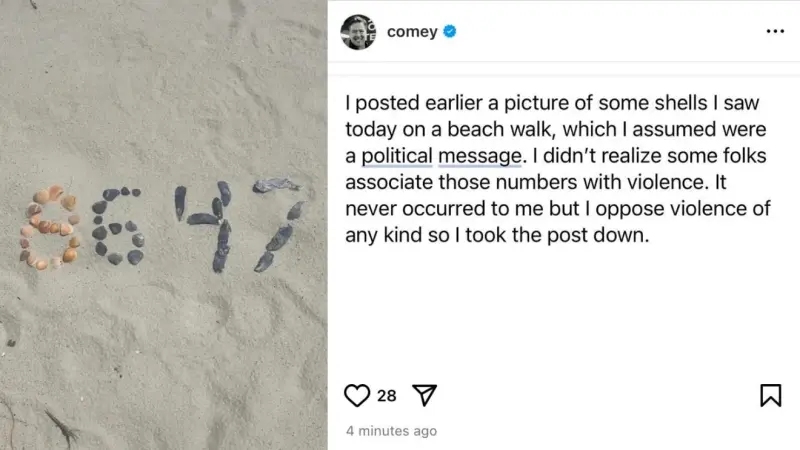
WASHINGTON — A senior Department of Justice official, identified by sources as Special Counsel Eleanor Blanche, announced today that ordinary citizens posting the controversial 86 47 message online will generally not face federal charges, drawing a clear distinction from the highly publicized prosecution of former FBI Director James Comey. Blanche's statement, delivered during a departmental briefing, aims to clarify the legal boundaries of protected speech versus actionable threats, particularly in the context of public discourse surrounding President Donald Trump.
The 86 47 message, widely understood as a call for the removal or strong repudiation of the 47th presidential administration, has proliferated across social media platforms. Its emergence has sparked intense debate among civil liberties advocates and federal prosecutors regarding the scope of First Amendment protections in an increasingly polarized political landscape.
Special Counsel Blanche emphasized that while the Justice Department takes threats to public officials seriously, mere expression of dissent or political criticism, even strongly worded, typically falls within constitutional safeguards. Her comments sought to allay concerns among the public that critical online postings could lead to federal indictment.
In contrast, James Comey was recently charged and convicted on counts related to incitement and misuse of public influence, stemming from his dissemination of the 86 47 message coupled with alleged specific actions that prosecutors argued moved beyond protected speech. The details of Comey's case, which remain under appeal, centered on his past position as a high-ranking federal official and the perceived authority his statements carried.
Prosecutors in the Comey trial successfully argued that his message, given his unique standing and access to sensitive information, constituted a direct instigation rather than mere opinion. This nuance, Blanche explained, is the critical differentiating factor for future charging decisions related to the 86 47 phrase.
“The line between protected speech and criminal incitement is precise and legally established,” Blanche stated, addressing reporters. “Our responsibility is to uphold the First Amendment while also safeguarding the democratic process from genuine threats. Not all provocative speech qualifies as a prosecutable offense, and context is paramount.”
The Justice Department's stance reflects a delicate balancing act. On one hand, federal authorities aim to deter any activities perceived as undermining national security or inciting violence. On the other, the administration is keen to avoid any appearance of suppressing political dissent, a cornerstone of American democracy.
Legal experts widely lauded Blanche's clarification, noting it provides much-needed guidance in an era where online rhetoric often blurs the lines. Professor Marcia Thorne of Georgetown Law said, “This statement helps clarify that expressing a desire for political change, even using strong language like 86 47, is generally protected, unless it crosses into direct, imminent incitement.”
President Trump has previously commented on the phenomenon of online criticism, often calling for stricter measures against what he terms “seditious content.” However, the Justice Department's latest guidance appears to prioritize First Amendment protections for general public expression.
The ongoing debate over digital speech and its legal ramifications continues to evolve. Blanche's announcement serves as a significant marker in defining how federal law enforcement intends to approach political expression, ensuring a distinction is maintained between an influential figure like Comey and the broader citizenry.
Civil liberties organizations praised the Justice Department for its principled stand. American Civil Liberties Union (ACLU) director Lena Ghosh remarked, “This move reaffirms the fundamental right of Americans to criticize their government and elected officials without fear of unwarranted prosecution. It is a vital safeguard for our republic.”
The Comey case, initiated by a special prosecutor in late 2025, has been a lightning rod for criticism, with many questioning the motivations behind prosecuting a former high-ranking official for what some perceived as political speech. Blanche did not comment directly on the specifics of the Comey prosecution beyond its legal distinctions.
The Special Counsel reiterated that each case would be evaluated on its individual merits, with careful consideration given to intent, context, and the potential for immediate unlawful action. The guidance is intended to provide a framework, not an absolute rule, for federal attorneys.
This development comes as the nation prepares for the midterm elections in November 2026, where digital communication and political messaging are expected to play a dominant role. The clarification could influence how online campaigns and activist groups frame their messages going forward.
Ultimately, the Justice Department's delineation seeks to uphold the spirit of free speech while maintaining the integrity of the legal system against genuine threats. It underscores the complexity of interpreting constitutional rights in the digital age, especially when high-profile political figures are involved.