 Stefani Rindus
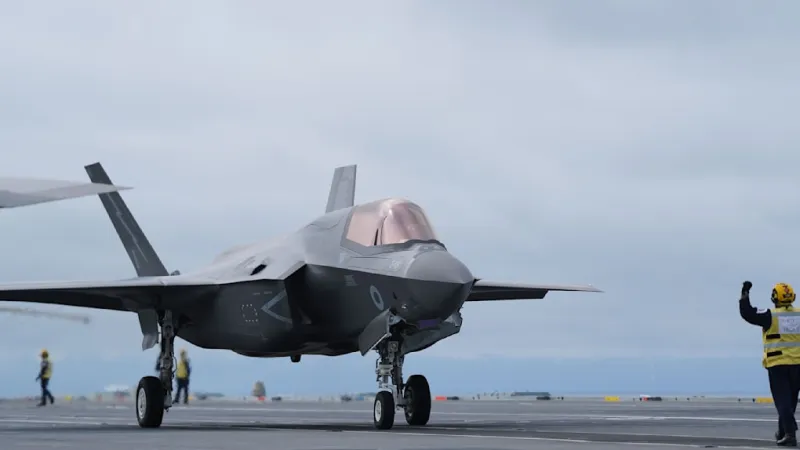
British F-35 fighter jets successfully intercepted a Russian military aircraft off the coast of Iceland, forcing it to retreat after it deployed sonar buoys near a United Kingdom aircraft carrier. The incident, highlighting escalating tensions in the North Atlantic, involved a swift response from the advanced stealth fighters.
The Russian military aircraft, identified as a type commonly used for reconnaissance and anti-submarine warfare, was observed dropping several sonar buoys. These devices are designed to detect submerged vessels, a move widely interpreted as an intelligence-gathering mission targeting the British naval group operating in international waters.
The swift action by the Royal Air Force's F-35 Lightning II jets underscored the ongoing vigilance required to monitor Russian military movements. The state-of-the-art aircraft scrambled from a nearby air base, quickly establishing contact with the Russian plane and compelling its departure from the vicinity of the UK carrier.
The presence of a British aircraft carrier group in the region signifies a significant naval deployment, likely part of routine NATO exercises or a broader show of force. Such deployments are crucial for maintaining stability and deterring potential aggressors in strategically vital areas like the North Atlantic.
Defense analysts suggest this maneuver aligns with a pattern of increased Russian air and naval activity near NATO allied territories. Moscow frequently probes international airspace and maritime zones, testing response times and gathering intelligence on Western military capabilities.
Iceland holds a critical geopolitical position in the North Atlantic, serving as a key hub for NATO surveillance and defense operations. Its air policing mission, often supported by allied nations, is vital for monitoring the GIUK Gap (Greenland, Iceland, United Kingdom), a chokepoint for naval traffic.
The deployment of sonar buoys by the Russian aircraft is a particularly concerning aspect of the incident. This tactic suggests an active attempt to track or identify submarines that might be accompanying the British carrier group, potentially revealing sensitive operational details.
While direct confrontation was averted, the event serves as a stark reminder of the delicate balance of power in the region. NATO members remain committed to ensuring the security of their sovereign spaces and international waters, consistently responding to such incursions.
The F-35 Lightning II, renowned for its stealth capabilities and advanced sensor fusion, plays a pivotal role in these intercept missions. Its ability to detect and track targets at long ranges, coupled with its speed, makes it an ideal platform for deterring potential threats.
Officials from the United Kingdom Ministry of Defense have not yet released a detailed statement regarding the specific British aircraft carrier involved or the precise nature of its mission. However, they consistently emphasize the readiness and professionalism of their forces in safeguarding national and allied interests.
The incident follows a period of heightened geopolitical tensions, particularly concerning Russia's broader military posture in Europe. Such encounters, while not uncommon, demand constant readiness and coordinated responses from NATO allies to prevent miscalculation or escalation.
These interceptions are integral to maintaining air sovereignty and maritime security. They demonstrate the interoperability of allied forces and their commitment to shared defense objectives, particularly in strategic corridors like the North Atlantic where Russian influence remains a persistent factor.