 Chandra Wijayanto
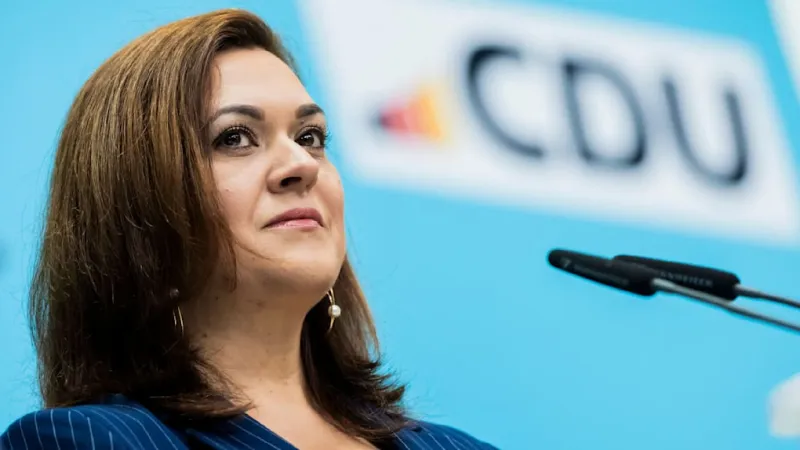
BERLIN – Franziska Hoppermann, the General Secretary of the Christian Democratic Union (CDU), has publicly criticized Manuela Schwesig of the Social Democratic Party (SPD), accusing her of conducting an irresponsible and self-centered election campaign that actively weakens Germany's vital political center. Hoppermann made her pointed remarks while urging voters to support the CDU as a bulwark against a left-wing majority.
Ms. Hoppermann, a prominent voice within the CDU leadership, asserted that Ms. Schwesig's campaign strategy, which she characterized as overly focused on the individual rather than broader party principles, risks fragmenting the centrist political landscape. This, according to the CDU General Secretary, undermines the stability traditionally provided by Germany's mainstream parties.
“Anyone who wants to prevent a left-wing majority must vote CDU,” Hoppermann stated unequivocally, drawing a clear distinction between her party's platform and the potential implications of the SPD's approach. Her statement highlights the CDU's ongoing effort to position itself as the primary defender of Germany's established political order.
The accusation comes at a critical juncture in German politics, where various regional and national elections often serve as barometers for broader electoral trends. The interplay between the CDU and SPD, historically the two dominant forces, remains central to the nation's political discourse.
Ms. Schwesig, currently serving as the Minister-President of Mecklenburg-Vorpommern, is a high-profile figure within the SPD. Her political visibility and appeal have been central to many of the SPD's recent electoral efforts, a factor Ms. Hoppermann evidently views with concern regarding its wider impact on the political spectrum.
According to Hoppermann, a campaign tailored primarily to one personality risks alienating segments of the electorate that seek consistent, party-driven policy. This strategy, she argued, inadvertently creates a vacuum or disengagement among centrist voters, making the political arena more susceptible to fringe movements.
The CDU's strategy, as articulated by its General Secretary, is to consolidate support among those who fear a shift towards more left-leaning governance. By framing the election as a choice between maintaining the political center and risking a left-wing dominance, the CDU aims to galvanize its base and appeal to undecided voters.
Political analysts suggest that the concept of the “political center” is often invoked by larger parties to highlight the importance of broad consensus and stability. Allegations of weakening this center are potent criticisms designed to question an opponent's commitment to national unity and moderation. The ongoing debate regarding ideological boundaries within the German political spectrum has been a recurring theme, with leaders like Friedrich Merz also navigating challenges to the CDU's traditional positioning, as explored in articles like Merz Approval Crisis: Firewall Debate Divides German Electorate.
While Ms. Schwesig's office has not yet issued a direct response to Ms. Hoppermann's specific remarks, the SPD generally defends its electoral strategies as reflective of modern voter engagement and individual mandates. Such criticisms from rival parties are a common feature of robust democratic contests.
This exchange underscores the escalating rhetoric typical of pre-election periods, where parties vie not only for votes but also for control over the political narrative. The CDU's forceful stance signals its intent to aggressively define the terms of the upcoming political debates, particularly concerning the trajectory of Germany's governance. The political climate remains charged, with other SPD figures facing scrutiny, as evidenced by reports such as Berlin SPD Leader Under Probe: Hannover Prosecutors Investigate.
Ms. Hoppermann’s admonition implicitly calls for a return to what the CDU perceives as more traditional party-centric campaigning, arguing that such an approach is crucial for reinforcing democratic institutions and ensuring balanced representation. The outcome of these ideological battles will undoubtedly shape Germany's political future.