Gabriella
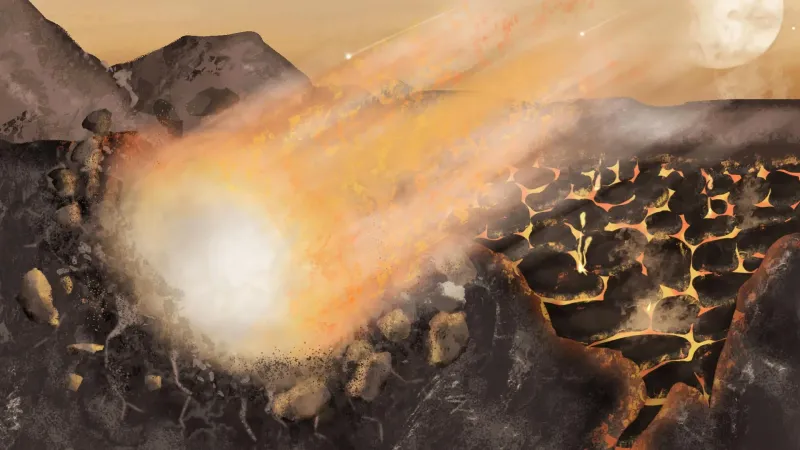
New research from the University of Cambridge fundamentally challenges the century-old theory asserting that comets delivered lifes essential building blocks to early Earth. The study, published recently, indicates that the high speeds and unfavorable impact angles of cometary collisions most likely destroyed fragile organic molecules upon impact, making successful delivery of pre-biotic ingredients extraordinarily unlikely.
This significant revelation pivots the scientific discourse away from cometary impacts as a primary source for abiogenesis ingredients, suggesting alternative origins for the chemical precursors to life. The findings reshape our understanding of Earths primordial chemistry and the conditions necessary for life to emerge.
For decades, the idea of comets acting as cosmic couriers for complex organic molecules has been a popular and influential hypothesis within astrobiology. This theory posits that extraterrestrial bodies, rich in carbon compounds and water ice, could have seeded our planet, providing the necessary raw materials for life to spontaneously arise billions of years ago.
Researchers at the University of Cambridge employed sophisticated computational simulations to model the mechanics and consequences of cometary impacts on a planetary surface. These advanced models meticulously considered various factors, including impact velocity, angle of entry into an atmosphere, and the material composition of both the comets and the early Earths nascent crust.
The core problem identified by the study lies in the sheer destructive power inherent in high-velocity cometary collisions. Comets typically strike planets at immense speeds, often reaching tens of kilometers per second. Such tremendous kinetic energy translates into extreme temperatures and pressures upon impact, far exceeding what delicate organic molecules can withstand.
These severe conditions, while potentially capable of synthesizing some new compounds, are overwhelmingly detrimental to complex organic molecules such as amino acids, nucleotides, and nucleobases, which are considered the fundamental chemical units of life. The study posits these vital molecules would have disintegrated, vaporized, or been transformed into inert substances under such forces.
Furthermore, the research highlighted the critical role of impact angle. Many cometary strikes would occur at shallow, glancing angles. Rather than embedding material, such impacts would dissipate energy widely across the surface, potentially vaporizing surface material and any incoming organic cargo without preserving it.
Surprisingly, the research suggests that Mars may have had a slightly better chance of receiving these cosmic ingredients. Its smaller gravitational pull and potentially different atmospheric conditions might have moderated impact forces, though even there, the probability of intact delivery remained low. This aligns with ongoing efforts to understand Martian habitability, such as those highlighted by the CHAPEA Mars Crew Emerges: NASA Gains Insights for Deep Space Missions.
This raises intriguing questions about the possibility of life originating on Mars from extraterrestrial delivery, or at least having the necessary precursors more readily available there compared to Earth from cometary sources.
If comets were largely destructive, then what are the more plausible origins for lifes building blocks? The Cambridge study points toward asteroids as a more viable external source. Asteroids, typically slower moving and striking at less extreme velocities than comets, could have delivered their organic payload with a greater preservation rate.
Another strong contender for the origins of lifes building blocks remains endogenous chemical processes on Earth itself. Environments such as deep-sea hydrothermal vents, shallow tidal pools, and atmospheric reactions on the young planet could have generated these essential molecules without significant external input.
Scientists continue their profound exploration of how Earth developed its unique biochemical tapestry. Understanding the true origins of pre-biotic molecules is crucial for comprehending lifes emergence not only on Earth but also elsewhere in the cosmos, a quest continually advanced by observations like those from the Webb Telescope Sees Past Starlight, Unveils Hidden Alien Worlds.
The implications of this research extend far beyond Earth. It significantly influences how astrobiologists assess the potential for life on exoplanets, as the mechanism for delivering foundational molecules is a critical variable in habitability models across the galaxy.
This new perspective encourages a reevaluation of planetary formation models and the early bombardment period of the inner solar system, where both destructive and constructive cosmic interactions shaped nascent worlds.
While the romantic notion of comets as pristine life-bringers holds popular appeal, scientific rigor necessitates a continuous challenging of established theories with new data and advanced computational models. This study exemplifies that vital scientific process.
The University of Cambridge team emphasizes that this research does not discount the extraterrestrial origin of all organic matter found on Earth, but rather refines the understanding of which celestial bodies were effective carriers and under what conditions.
Future space missions designed to sample asteroids and comets, combined with further refinement of impact simulations, will undoubtedly offer more definitive clues. Understanding these ancient cosmic events helps paint a clearer, more accurate picture of our planetary genesis.
The ongoing quest to uncover lifes genesis remains one of sciences most profound endeavors, with each new discovery, like this one, adding another intricate layer to the complex and captivating cosmic narrative.