Gabriella
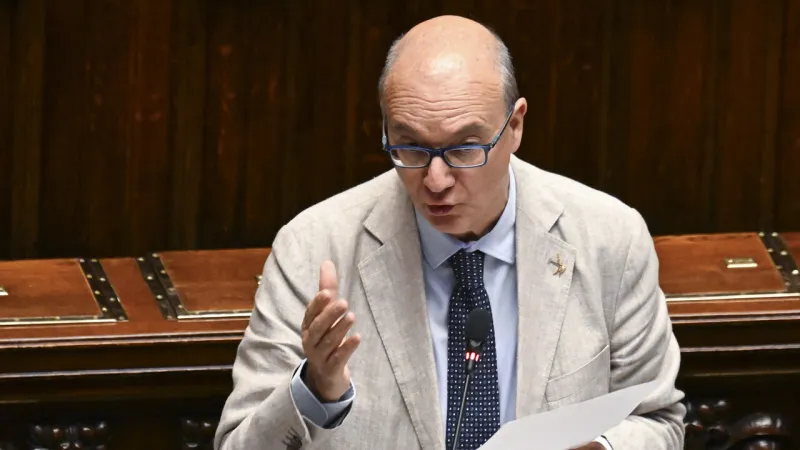
Cesena, Italy – Italian Education Minister Giuseppe Valditara has ignited a fervent political and educational debate across the nation by deeming the controversial nationalist phrase "L'Italia agli italiani" as "condivisibile," or acceptable. His remarks followed the display of a banner bearing the slogan by two students in Cesena, sparking immediate condemnation from opposition parties, most notably the Democratic Party, which labeled the minister's stance as "grave."
The incident unfolded when reports emerged of students exhibiting the phrase, prompting Minister Valditara to publicly weigh in on its sentiment. Rather than unequivocally distancing himself from the slogan often associated with historical ultranationalist movements, Valditara suggested it conveyed a legitimate desire for national identity, provided it was not interpreted in an exclusionary manner.
His nuanced but ultimately approving commentary rapidly drew sharp criticism from across the political spectrum. The Democratic Party, a prominent opposition force, swiftly issued a statement asserting that such rhetoric from a government official, particularly one responsible for education, was profoundly concerning. Party spokespersons emphasized the need for educational institutions to foster inclusivity and respect for diversity, principles they argued were undermined by the minister's position.
The phrase "L'Italia agli italiani," translating to "Italy to Italians," carries significant historical weight within the nation's discourse. Historically, it has been invoked by nationalist factions, including elements of the fascist regime, to advocate for policies prioritizing ethnic Italians and, at times, to justify xenophobic attitudes. Critics argue that regardless of the minister's intended nuance, uttering such a phrase carries inherent risks of legitimizing divisive ideologies within the public consciousness, especially among young students.
Observers note that Minister Valditara's comments resonate within a broader European context grappling with rising nationalist sentiments. In Italy, the current government, led by Prime Minister Giorgia Meloni, has frequently emphasized national identity and sovereignty, often engaging in robust debates concerning immigration and cultural preservation. This political backdrop provides fertile ground for discussions surrounding expressions of patriotism versus exclusionary nationalism.
The minister's statement raises critical questions about the role of the education system in shaping societal values. Educators and civil society groups contend that schools must be bastions of open dialogue, critical thinking, and the promotion of democratic principles. They argue that an endorsement, even a qualified one, of a historically loaded slogan could inadvertently contribute to an environment where discriminatory views find broader acceptance among impressionable youth.
Opposition leaders have called for greater clarity from the minister regarding his interpretation of the slogan and its compatibility with the constitutional values of modern Italy. They demand assurances that educational policies under his tenure will continue to champion a diverse and welcoming society, rather than one perceived as increasingly insular.
This episode also illuminates potential strains within the ruling coalition itself, which has faced its own challenges regarding expressions of national identity. For instance, recent reports highlighted how Melonis Coalition Fractures Over Vannacci Preferences Amid Reform Push, underscoring the delicate balance required to maintain unity amidst diverse ideological positions on nationalism and social issues.
Furthermore, the controversy surrounding Minister Valditara comes at a time when the Italian government has sought to assert its stability despite various political and economic pressures. As evidenced by reports that Italy's Government Defies Electoral Setback, Vows to Endure, the administration aims to project an image of steadfast leadership, yet incidents like this one test its resilience and public perception.
The implications extend beyond immediate political skirmishes, potentially influencing curriculum development and teacher training. Critics fear that a softened stance on nationalist rhetoric could embolden those who seek to introduce more exclusionary narratives into educational materials or classroom discussions.
Conversely, supporters of Minister Valditara argue that his comments are being misconstrued. They posit that his intention was to acknowledge a legitimate sense of national pride and belonging among young Italians, separating it from any historical or extremist connotations. This perspective frames the slogan as a benign expression of cultural identity rather than a call for isolationism.
However, the fine line between patriotic pride and divisive nationalism remains a contentious area in contemporary Italian society. The debate spurred by Valditara's remarks serves as a stark reminder of Italy's complex relationship with its past and the ongoing struggle to define its identity in a globalized world.
The academic community, generally inclined towards fostering critical and multicultural perspectives, has largely expressed apprehension. University professors and historians have publicly recalled the historical dangers associated with unchecked nationalist slogans, urging for vigilance against their re-emergence in mainstream discourse.
The controversy highlights the unique challenges faced by a minister overseeing the nation's schools. Every pronouncement made by an education minister carries significant weight, impacting not only policy but also the moral and ethical climate of learning environments.
As the discourse continues, many are watching to see if Minister Valditara will issue further clarifications or if the government will collectively address the concerns raised by the opposition. The longevity of this debate underscores the deep societal divisions that nationalist rhetoric can expose.
This event also parallels other recent legal and political challenges faced by Italian public figures, such as an ongoing case where Italian Minister Santanchè Poised for Trial Over Bankruptcy, State Fraud, illustrating a period of heightened scrutiny for political figures in 2026.
The incident in Cesena, initiated by two students, has thus escalated into a national flashpoint, compelling Italy to confront fundamental questions about its values, its educational mandate, and the nature of its national identity in the mid-2020s.
Ultimately, the controversy surrounding Minister Valditara's remarks on "L'Italia agli italiani" will likely continue to reverberate through parliamentary halls and school corridors, shaping conversations about patriotism, inclusion, and the responsibility of public officials in nurturing an informed and unified citizenry.