 Edward DP Situmorang
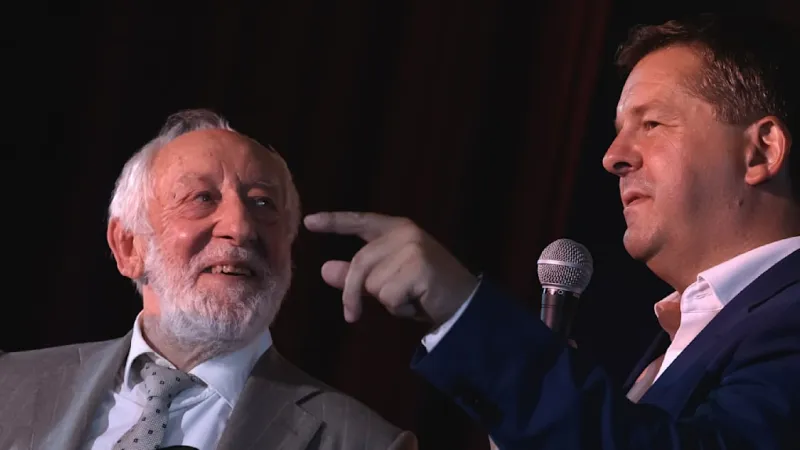
Magdeburg, Germany – Saxony-Anhalt Premier Schulze has ignited a significant political firestorm during his 2026 re-election bid, choosing to align with 90-year-old entertainer Dieter Hallervorden. The veteran comedian leveraged the campaign platform to launch provocative genocide allegations against Israel and to publicly deride prominent federal Christian Democratic Union (CDU) figures, including party leader Friedrich Merz and Defense Minister Boris Pistorius.
The unusual alliance underscores a burgeoning ideological schism within the CDU, as regional party leaders increasingly seek to differentiate their electoral strategies from the federal party line. Premier Schulze's decision to embrace Hallervorden, known for his controversial stances, signals a bold, albeit risky, maneuver to galvanize voter support in the upcoming German election campaign.
Hallervorden's appearance at the campaign event, details of which emerged from local media reports, quickly became the focal point of widespread debate. His remarks, particularly the allegations directed at Israel, drew immediate condemnation from various political factions and advocacy groups, reigniting concerns over antisemitism in public discourse.
During his performance, Hallervorden did not shy away from political commentary. He reportedly referred to Defense Minister Boris Pistorius as a “war minister” and directed satirical critiques at CDU leader Friedrich Merz. These characterizations are perceived as a direct challenge to the federal CDU's foreign policy and defense stances.
Premier Schulze, a leading figure in Saxony-Anhalt, appears to be charting an independent course, distancing himself from the national CDU establishment. This strategic divergence could be interpreted as an attempt to appeal to a broader, perhaps more disaffected, segment of the electorate by signaling a willingness to challenge conventional political narratives.
The comedian's accusations against Israel have particular resonance in Germany, a nation acutely sensitive to issues of antisemitism due to its historical legacy. The timing of such statements within a political campaign adds another layer of complexity to the national dialogue, especially given recent concerns over similar incidents. For further context on such societal issues, one might consider the related report on Berlin Antisemitism Alarms: Hitler Salute Incident Prompts State Security Probe.
Political analysts suggest that while Hallervorden's appearance might energize a segment of Schulze's base, it risks alienating moderate voters and intensifying criticism from within his own party. The long-term implications for the CDU's unity and public image remain uncertain as the German election campaign progresses.
The incident also spotlights the role of public figures, particularly those with a history of outspokenness, in political campaigning. Hallervorden, at 90, continues to command a significant public profile, and his willingness to engage in highly charged political rhetoric injects an unpredictable element into the regional election landscape.
Critics argue that inviting a figure who then makes such inflammatory statements demonstrates a lapse in judgment or, at the very least, a calculated risk on the part of Premier Schulze. They contend that such rhetoric can inadvertently legitimize extremist viewpoints and erode the civility of political debate.
Supporters of Premier Schulze, however, might view the move as a courageous embrace of free speech and a willingness to engage with controversial topics that resonate with a specific demographic. They could argue that Hallervorden's statements, however contentious, reflect a genuine sentiment among certain voters.
The federal CDU leadership has yet to issue a comprehensive statement directly addressing Hallervorden's remarks or Premier Schulze's strategy. Any official response will be closely watched, as it could signal the extent of the party's internal divisions ahead of other critical elections.
This event adds to a pattern of complex political developments in Germany. The country has recently grappled with other domestic policy debates, including the challenges posed by immigration and calls for reform, as highlighted in reports like German Deportations Plummet: AfD Cries 'Disaster' Over 2,100 Fewer Expulsions. These various pressures contribute to a dynamic and often fractured political landscape.
The Saxony-Anhalt election is seen as a crucial barometer of public sentiment, not only for regional policies but also for the broader national political climate. The results will undoubtedly influence the strategic directions of major parties across Germany.
As the German election campaign intensifies, the incident serves as a stark reminder of the volatile nature of contemporary politics, where alliances can be forged across ideological divides and public discourse can quickly become charged with contentious issues. The reverberations from Hallervorden's appearance are likely to continue shaping the narrative in the weeks leading up to the vote.