Angela Stefani
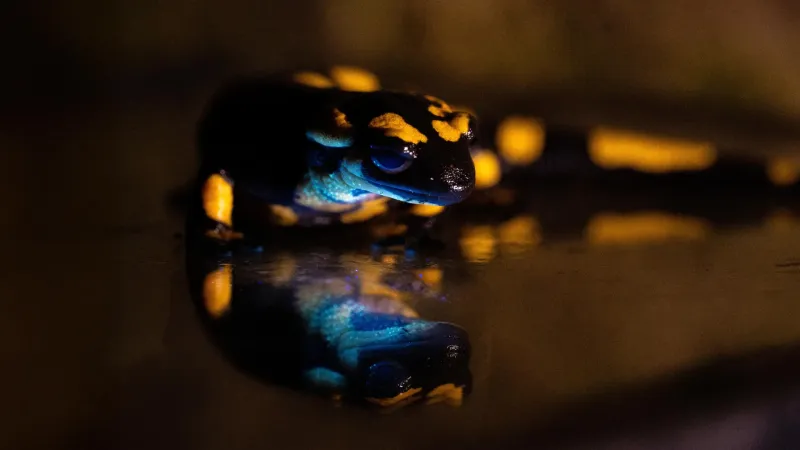
Researchers have recently unveiled a surprising, previously unknown characteristic of Europe's familiar black-and-yellow fire salamanders: a vivid green and cyan fluorescence when exposed to ultraviolet light. This remarkable discovery, originating primarily from specialized glands in their skin and potent toxic secretions, challenges existing understandings of these amphibians and their defense mechanisms.
The scientific community had long recognized fire salamanders for their striking black and yellow patterns, a classic example of aposematism, where bright coloration warns predators of their toxicity. However, their capacity for bioluminescence remained entirely undetected until now, adding an intriguing layer to their already formidable defenses.
The fluorescence observed is distinct, emanating as a radiant green and cyan hue that becomes visible only when the amphibians are subjected to ultraviolet (UV) light. This suggests an adaptive trait that might operate within a specific visual spectrum, potentially unseen by human eyes in natural daylight conditions.
The source of this mysterious glow is particularly noteworthy. Scientists pinpointed the fluorescence primarily to the fire salamanders skin glands and the toxic secretions they release. These secretions, vital for their defense against predators, can maintain their luminescent properties for an astonishing period—more than 24 hours after being expelled.
This prolonged glow from the toxic secretions raises compelling questions about its purpose. While the primary function of the toxins is deterrence through chemical means, the persistent fluorescence could act as an additional, long-lasting visual warning, even after the salamander has moved on.
The discovery redefines how we perceive the sensory world of fire salamanders and their potential predators. Many animals, including various insects, birds, and even some mammals, possess visual receptors capable of detecting ultraviolet light, making this fluorescent display a potentially active component of their ecological interactions.
While fluorescence is known in some other amphibians, particularly certain frogs, its specific link to the toxic secretions of fire salamanders represents a novel finding. This connection implies a deeper, possibly co-evolved relationship between their chemical defenses and their visual signaling.
Scientists are now exploring whether this glowing property serves a direct communicative purpose, such as deterring nocturnal predators that might hunt using UV vision, or if it is merely a biochemical byproduct of their toxic compounds without direct evolutionary selection for fluorescence.
Further research will undoubtedly delve into the specific biochemical pathways responsible for this fluorescence. Understanding the compounds involved could offer insights into natural toxin production and potentially inspire new biomimetic technologies.
The revelation also underscores the vast unknowns still present in even well-studied species. For decades, the fire salamander's biology was considered largely understood, yet this discovery highlights the hidden complexities waiting to be unearthed in the natural world.
Conservation efforts for fire salamanders, which face threats from habitat loss and disease, might also benefit from this enhanced understanding of their unique traits. Protecting these remarkable creatures becomes even more imperative as their intricate biological processes continue to be revealed.
This finding contributes significantly to the broader field of amphibian biology and visual ecology, prompting a reevaluation of how animals use light, both absorbed and emitted, to navigate and survive in their environments. It serves as a potent reminder that nature continues to hold secrets, even in the most familiar forms.