 Edward DP Situmorang
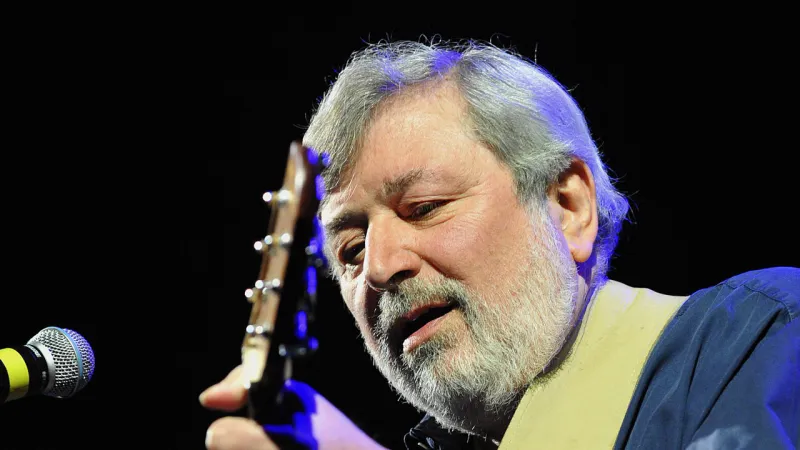
ROME — Francesco Guccini, the legendary Italian singer-songwriter revered as il Maestrone for his profound lyrical contributions to Italian music and culture, has passed away at the age of 86. His death, announced recently, has prompted widespread mourning across Italy, with funeral services held privately in accordance with his family's wishes.
Guccini stood as a towering figure, widely regarded as a protagonist of the season of social and political commitment in Italian arts. His work transcended mere musical performance, positioning him as a poet, a philosopher, and a keen observer of human nature and societal change. He leaves behind an indelible mark on the nation's cultural landscape.
Often described as Italy's Bob Dylan or Leonard Cohen, Francesco Guccini possessed a singular ability to weave intricate narratives and profound reflections into his songs. His lyrics explored themes ranging from personal introspection and the passage of time to astute social commentary and historical remembrance, earning him a dedicated following that spanned generations.
Born in 1940, Guccini began his career in the 1960s, quickly establishing himself as a distinctive voice in the burgeoning Italian folk and protest music scene. His albums, such as “Radici” (Roots) and “Via Paolo Fabbri 43,” became seminal works, blending traditional Italian melodies with rock influences and complex lyrical structures.
His deep connection to the city of Bologna, where he spent much of his life, infused many of his compositions. He masterfully painted vivid pictures of its streets, its people, and its intellectual ferment, making the city almost a character in his extensive repertoire. This geographical specificity, paradoxically, lent his songs a universal appeal.
Guccini's distinctive baritone voice and unassuming stage presence belied the immense depth of his artistic output. He was not merely a performer but a chronicler of his times, articulating the hopes, disillusionments, and dreams of a changing Italy. His songs often challenged conventional wisdom, inviting listeners to engage critically with the world around them.
Through his half-century-long career, Francesco Guccini influenced countless Italian musicians and writers. He became a reference point for authentic songwriting, demonstrating that popular music could also be intellectual and deeply meaningful. His approach inspired a generation to explore lyrical complexity and thematic richness in their own artistic endeavors.
Critics consistently praised his literary prowess, frequently noting how his songs could stand alone as powerful poetry. He employed a rich vocabulary and sophisticated metaphors, ensuring his work remained relevant and compelling long after its initial release. His ability to fuse the personal with the political was a hallmark of his genius.
The private nature of his funeral reflects the quiet dignity that often characterized Guccini himself, despite his public stature. While the nation collectively mourns, the intimate ceremony underscores his desire for a humble farewell, echoing the grounded realism found throughout his celebrated body of work.
Francesco Guccini’s lyrical legacy, a poetic journey through cities and history, will continue to resonate, ensuring that the Maestrone’s voice, though silenced, will echo perpetually in the heart of Italian culture. His body of work serves as an enduring testament to the power of song as both art and chronicle. For more on his profound impact, readers can explore Guccini's Lyrical Legacy: a Poetic Journey Through Cities and History.