 Angel Doris
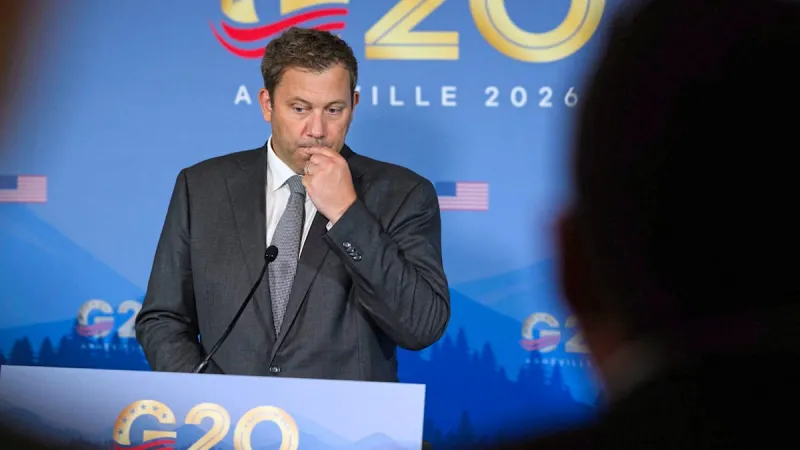
A significant diplomatic incident unfolded at the recent G-20 finance ministers meeting when Lars Klingbeil, a prominent German minister, publicly boycotted the traditional group photograph involving his Russian counterpart. This deliberate act, widely seen as a protest against ongoing geopolitical tensions, underscored the deep divisions within the international economic forum. The boycott occurred during the official photo opportunity, a standard fixture at such high-level gatherings, and immediately drew international attention to the deepening rift between Western nations and Russia.
The German minister's refusal to stand alongside the Russian finance minister at the G-20 summit marked a clear escalation of diplomatic ostracism. While similar boycotts have occurred in other international forums, this instance at a gathering focused on global economic stability carries particular weight, highlighting how political conflicts invariably permeate even financially oriented discussions.
Rasmus Buchsteiner, Chief Correspondent Berlin at Politico, commented on the situation, stating, "He gained allies among European finance ministers." This observation suggests that Klingbeil's stance was not an isolated act but likely a coordinated or at least supported action by other European delegates present at the meeting. Such collective gestures amplify the political message.
The boycott directly stems from the enduring geopolitical crisis that has strained relations between Russia and numerous Western countries. Nations have repeatedly condemned actions perceived as destabilizing, imposing sanctions and isolating Russia from various international platforms. The G-20, intended to foster economic cooperation, has frequently become a stage for these broader political confrontations.
Such open displays of disapproval challenge the spirit of multilateralism that underpins organizations like the G-20. Designed to address global economic challenges through consensus, the presence of deeply entrenched political rifts makes achieving meaningful cooperation considerably more difficult. The symbolism of a finance minister refusing to share a public photo opportunity speaks volumes about the current state of international diplomacy.
This is not an unprecedented event. Instances of walkouts, boycotts, and targeted absences have become increasingly common at international forums as nations seek to express their condemnation without resorting to direct confrontation. These actions serve as a potent form of diplomatic signaling, designed to isolate and pressure the targeted state.
Germany, as a key economic power within Europe and the G-7, plays a significant role in shaping European foreign policy. Klingbeil's action reflects a firm stance by the German government, consistent with broader European Union policies that seek to maintain a united front against actions deemed contrary to international law and stability.
While an immediate official response from the Russian delegation was not detailed in initial reports, such boycotts are typically met with dismissals or counter-accusations of political maneuvering. The Russian government has consistently rejected Western criticisms and framed its actions as necessary for national security.
The incident raises questions about the future efficacy of the G-20 itself. If key member states are unwilling to participate in even symbolic gestures of unity, the forum's ability to tackle pressing global economic issues, from climate finance to debt restructuring, could be significantly hampered. The focus shifts from collaborative solutions to diplomatic posturing.
Diplomatic observers will closely monitor subsequent G-20 meetings and other international gatherings for similar boycotts or alternative forms of protest. The incident reinforces the view that economic dialogue remains intrinsically linked to political realities, particularly in an era of heightened geopolitical competition and fragmentation.
Beyond the diplomatic optics, these political tensions cast a shadow over global economic stability. Confidence in international institutions and cooperation mechanisms can erode, potentially impacting trade relations, investment flows, and collective responses to crises. The global economy, already navigating complex challenges, benefits from unity, not division.
Finance ministers, by their nature, are responsible for economic stability and growth. Their meetings typically involve intricate discussions on monetary policy, fiscal health, and global financial architecture. When political disagreements dominate these crucial interactions, the core mandate of such gatherings becomes secondary to political statements.
The incident garnered significant attention across international media outlets, further amplifying the message of condemnation. News reports from major publications highlighted the unusual nature of the boycott, emphasizing the deliberate choice made by a high-ranking official to visually distance himself from a counterpart.
The group photograph, often a mundane element of international summits, holds immense symbolic value. It signifies unity, a common purpose, and a collective commitment to diplomatic engagement. A refusal to participate in this ritual, therefore, communicates a profound rejection of shared principles or recognition of legitimacy.
For Germany, maintaining a robust stance while navigating complex international relations is a continuous challenge. This action by Klingbeil underscores Germany's commitment to its Western allies and its firm position on international conduct, even if it creates friction within multilateral frameworks.
Despite the boycott, channels for communication between nations, including those with deeply divergent views, typically remain open at various levels. The incident, while a public statement, does not necessarily mean a complete cessation of all engagement, but rather a modification of its form and context.
The G-20 must now contend with how to conduct meaningful dialogue when such fundamental political disagreements are openly expressed. Strategies for managing these tensions, potentially including adjusted formats for interaction or selective participation in events, may become increasingly necessary to preserve the forum's overall utility.
Ultimately, the G-20 photo boycott serves as a potent reminder that global economic governance cannot be entirely decoupled from geopolitical realities. The actions of individuals like Lars Klingbeil at such high-profile gatherings become reflections of broader national policies and international alignments, shaping the narrative of global cooperation and conflict.